

Innovation in life sciences has reshaped medicine over the past decade, delivering breakthroughs once thought impossible. Hepatitis C is now curable, HIV patients have moved from lifelong treatment to remission, and immuno-oncology continues to extend survival for cancer patients. Covid-19 vaccines, meanwhile, not only saved millions of lives but also accelerated how quickly science can scale.
But in 2025, it’s no longer just the research bench that drives transformation. The life sciences commercial model is undergoing its own reinvention - powered by omnichannel engagement, advanced analytics, and AI-driven personalization. The challenge now is not starting innovation, but scaling commercialization strategy to match the pace of scientific progress.
Accelerating Commercialization Strategy in Life Sciences
Over the past few years, the life sciences commercial model has made meaningful strides. Companies have embraced hybrid engagement, invested in omnichannel platforms, and piloted AI in life sciences applications that improve targeting and personalization. These advances mark a clear break from the one-size-fits-all playbooks of the past.
Yet progress is not enough. Scientific breakthroughs are moving faster than ever, and customer expectations continue to rise. To keep pace, the industry must scale innovation and commercialization more decisively - moving beyond pilots and isolated experiments to systematized, enterprise-wide change.
That means building a commercialization strategy that is:
Faster, adapting quickly to shifting HCP preferences and regulatory dynamics
Smarter, powered by real-time analytics and AI pharma commercial models
Seamless, ensuring that omnichannel experiences replace fragmented multichannel marketing in life sciences
Innovation has begun at the commercial end of the value chain. Now the challenge is to do more, and do it faster - so the full value of scientific progress reaches healthcare professionals (HCPs) and patients without delay.
Digital Trends in Life Sciences Reshaping Commercialization
Several powerful trends are defining life sciences commercial models in 2025:
Hybrid engagement is becoming the common expectation. Field reps, virtual sales, and digital platforms are no longer separate tactics but parts of a unified strategy. This marks a decisive move beyond multichannel marketing in life sciences toward true omnichannel orchestration.
Digital affinity is reshaping engagement. Indegene’s data shows one-third of HCPs are already digital enthusiasts or regulars, while 40% are still developing their digital habits. Specialty differences are stark: cardiology and endocrinology are early adopters, but anesthesiology and surgery lag. Even older HCPs (ages 50–70) are more digitally engaged than expected, proving digital-first strategies must be nuanced, not one-size-fits-all.
AI-powered personalization at scale. Companies are using generative AI to tailor content to individual HCP needs, predict next-best actions, and adapt campaigns in real time. As of early 2025, 32% of life sciences organizations have moved from experimentation to scaling GenAI, and 5% say they’ve achieved sustained competitive advantage.
Data as the driver of agility. Real-time analytics and adaptive content strategies are empowering commercial teams to pivot campaigns while they are live - shifting resources, refining messaging, and targeting HCPs more precisely. By letting data guide every adjustment, companies are optimizing engagement and ROI continuously, rather than waiting for end-of-cycle results
Together, these digital trends in life sciences represent a shift from experimentation to enterprise adoption. Commercial leaders now face the challenge (and opportunity) of scaling these innovations across therapy areas, geographies, and brands.
Digital Rep Equivalence – Human Impact, Digital Scale
The field-rep model has always been central to pharma, but it no longer stands on its own. HCPs now expect flexibility: sometimes a face-to-face interaction, other times a quick digital exchange, and often a seamless blend of both. This is where digital rep equivalence (DRE) comes in.
At its heart, DRE is about giving every HCP the same quality of experience they’d expect from a trusted rep - only scaled through digital-first, data-driven channels. By analyzing well over 2.1 million real world HCP interactions, DRE can surface the right moment, the right message, and even the right format to engage - replicating the personal relevance of an in-person conversation, but with far greater reach.
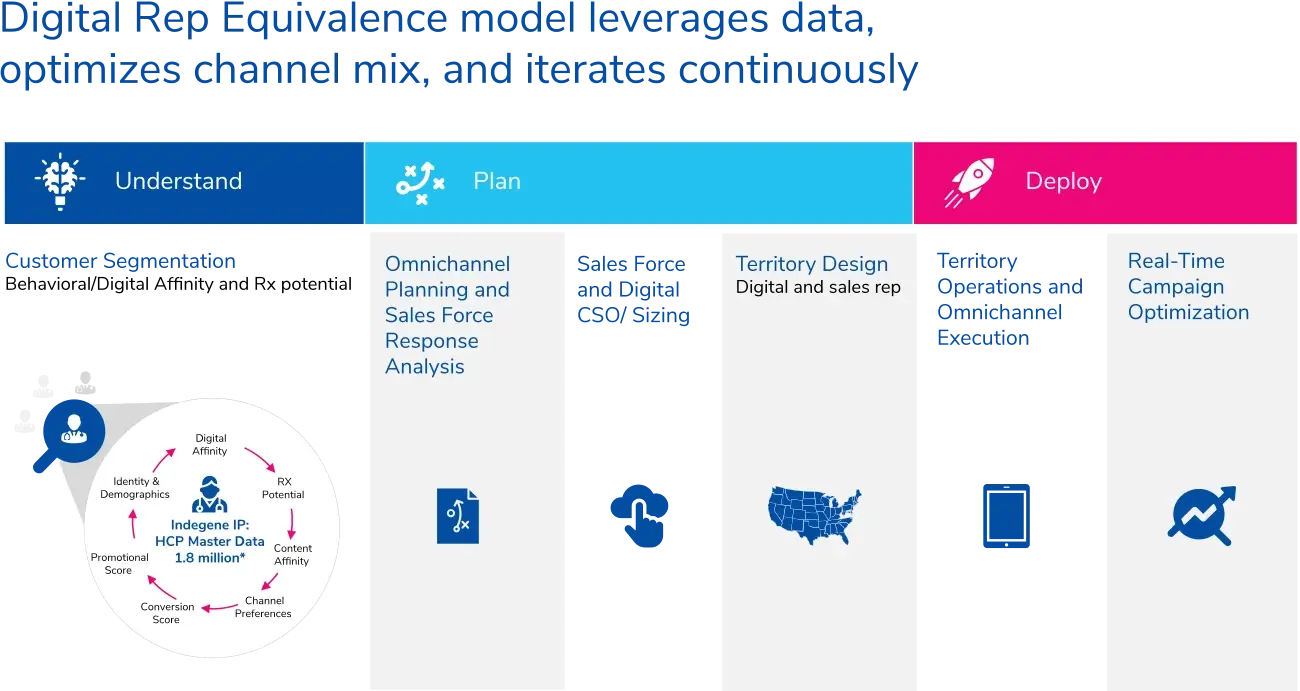
What makes this powerful is that it doesn’t replace your field team; it complements them. DRE ensures that innovation and commercialization flow together: empowering reps with sharper insights, extending access to physicians who are hard to see in person, and maintaining consistency across email, virtual, and programmatic channels. For HCPs, it feels like a connected, personalized journey. For companies, it means broader coverage, higher efficiency, and stronger ROI.
In many ways, DRE is the bridge—linking the human strengths of field engagement with the efficiency and precision of digital innovation. It turns omnichannel ambition into everyday execution, and in doing so, redefines how life sciences commercial models will scale in 2025 and beyond.
Conclusion – Simple Solutions for Complex Times
Innovation in life sciences has always been defined by bold breakthroughs - curing diseases once deemed incurable, extending lives, and reshaping global health. But in today’s environment, the industry’s success depends equally on how well it can scale life sciences commercial innovation.
Omnichannel engagement, AI pharma commercial models, and digital rep equivalence are no longer pilots - they are becoming systematized practices. The opportunity now lies in moving faster, aligning strategy to execution, and ensuring that innovation and commercialization flow seamlessly from the lab bench to every HCP interaction.
When commercialization innovation is applied with the same discipline as R&D, it simplifies execution, elevates impact, and builds stronger, more trusted relationships with HCPs. The next era of growth for pharma will be shaped not just by what science can achieve, but by how effectively the industry can scale its commercialization strategy to deliver those advances to patients everywhere.