For pharma, the next phase of digital transformation is less about adding technology and more about changing how the organization operates around it. As customer expectations rise, competition intensifies, and AI reshapes what is operationally possible. Legacy structures built around brands, functions, and long implementation cycles are increasingly becoming constraints.
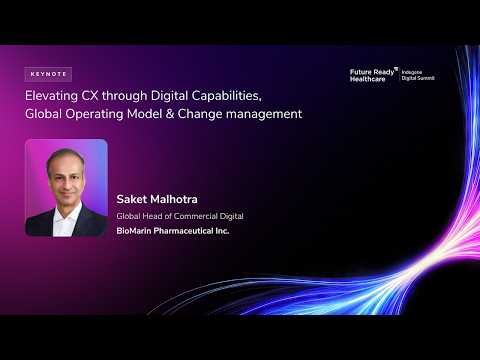
At the Indegene Digital Summit 2026, Saket Malhotra, Global Head of Commercial Digital, BioMarin Pharmaceutical Inc., shared how BioMarin approached this challenge by starting with business outcomes and then redesigning capabilities, governance, market sequencing, and ways of working around them. The experience offers a broader lesson for pharma leaders: technology can accelerate transformation, but the operating model determines whether that transformation creates measurable value.
Start With Business Gaps, Not Technology Capabilities
BioMarin began by looking outward at changing patient and customer expectations, emerging competition, and digital innovation, while simultaneously looking inward at its own business priorities and operating constraints. That exposed tangible gaps: identifying and progressing patient opportunities could take eight to ten weeks, while even relatively simple campaigns could take four to six months to activate.
Those gaps became the basis for prioritization. Rather than asking where AI, analytics, or new platforms could be deployed, the organization asked which business outcomes needed to change, and which capabilities would be required to change them.
For pharma leaders, this reverses a familiar transformation sequence. The business case should determine the technology roadmap, not be constructed afterward to justify it.
Turn Transformation Into An Enterprise Objective
Building capabilities were only part of the equation. BioMarin translated its transformation agenda into three outcome areas spanning insights-driven marketing, customer experience, and field excellence, supported by six cross-functional programs across commercial, medical, and market access.
More importantly, the transformation was elevated to one of the company’s corporate objectives, with C-suite and CEO backing. That shifted digital transformation from a functional initiative into an enterprise commitment, making it easier to establish accountability and mobilize different parts of the organization around the same outcomes.
The implication is significant. Transformation gains momentum when leadership makes it part of how enterprise performance is defined, rather than leaving digital teams to create adoption for one stakeholder at a time.
Centralize Capability Without Losing Market Context
Building on that foundation, BioMarin made a deliberate operating model choice. Instead of distributing accountability through a federated structure, it created an integrated global center of excellence designed to bring greater speed, maturity, and accountability.
But centralization did not mean moving decision-making further away from the business. The global function established presence across the US, Europe, LATAM, and Japan, while business champions and customer boards brought functional and local-market knowledge into the model. That mattered because executing in the US is fundamentally different from navigating works councils in Germany or regulatory and market dynamics in Japan.
This creates an important distinction for global pharma organizations: scale comes from standardizing what should be common while preserving the local intelligence required to make those capabilities work.
Prioritize Markets for Impact, Not Convenience
The same discipline shaped rollout. With operations spanning approximately 90 markets, BioMarin did not sequence markets simply according to implementation ease. It considered factors including revenue, growth, compliance, and competitive dynamics to determine where capabilities should launch.
Malhotra challenged the conventional instinct to begin with something small simply because it is easier to demonstrate success. His recommendation was to include markets where the business impact could be meaningful enough to prove value and build organizational confidence.
That changes the logic of the traditional transformation pilot. The objective should not be to minimize the risk of the first implementation; it should be to generate evidence strong enough to justify the next wave.
Use AI to Redesign Work, Not Simply Accelerate It
Once the organizational foundation was in place, AI became part of how work itself was executed. BioMarin described moving from identifying leads over eight to ten weeks to identifying opportunities daily using AI and new data signals. Campaign activation moved from four to six months to two to three weeks.
The operating model also began to incorporate agents into always-on campaigns and customer and patient journeys. Rather than executing a predetermined sequence of interactions, these journeys can learn from engagement and performance indicators and dynamically influence what happens next. AI is also being applied across areas such as targeting, segmentation, and field intelligence.
The strategic shift is therefore larger than automation. AI begins to change the commercial model when it moves from helping people execute existing processes to enabling processes that could not operate at the same speed or responsiveness before.
Measure Transformation Through Value Realization
Extending the discussion, BioMarin embedded measurement into the transformation from the beginning. Programs were linked to defined success measures and leading and lagging indicators, while investments were supported by business cases and ROI expectations tailored to different stakeholders.
Within roughly the first year of the journey, field excellence capabilities had been launched in major European markets, Japan, and the US at different speeds based on market complexity. Malhotra also reported a 50% reduction in agency investment alongside faster execution and greater intelligence.
This matters because transformation programs often measure implementation milestones more rigorously than realized business value. For leaders, the stronger governance question is not simply whether a capability went live, but whether it changed speed, cost, adoption, engagement, or another outcome the business actually values.
Make Change Management Part of The Operating Model
Across each of these shifts, change management was not treated as the final step after technology deployment. Business champions were embedded in the core team; cross-functional customer boards created ongoing governance, and compliance, legal, IT, and business stakeholders were brought into the transformation.
This structure helped move the organization from a brand-centric model toward a more customer-, patient-, and outcome-oriented way of working. It also created the organizational trust required to introduce new capabilities quickly and expand them once value became visible.
For pharma leaders, the lesson is straightforward: adoption cannot be a downstream workstream. It has to be designed into governance, accountability, and execution from the beginning.
Where Technology Meets Business Transformation
BioMarin’s experience reinforces that the defining challenge of AI-era transformation is not simply deploying more advanced technology. It is building an organization capable of turning that technology into business value through sharper prioritization, globally connected operating models, local accountability, measurable outcomes, and new ways of working.
The organizations that move fastest may therefore not be those with the most technology. They will be those that redesign the business around what technology now makes possible.
