Pharma's customer engagement model is approaching an inflection point. As AI becomes embedded into clinical workflows, customers gain faster access to information, and traditional channels become less influential, the question is no longer how to reach customers. It’s how to remain relevant when customers can access answers before they engage with you.
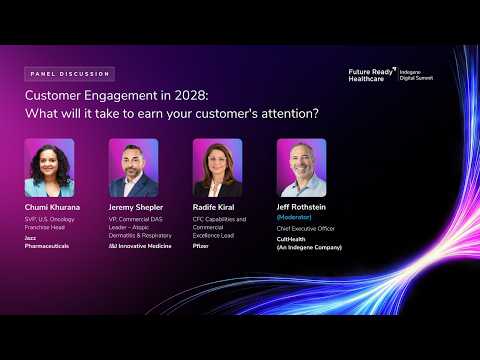
At the Indegene Digital Summit 2026, leaders from across the life sciences industry came together to explore what customer engagement could look like in 2028. The discussion moved beyond digital channels and marketing tactics to examine a more fundamental shift: from controlling information to earning trust, from managing campaigns to solving customer problems, and from functional silos to connected experiences.
When AI Becomes the First Point Of Engagement
The session opened with a provocative scenario. By 2028, a physician may no longer visit a pharma website or contact a representative for information. Instead, they could ask an AI agent integrated into their electronic health record system to summarize the available evidence for a treatment option. The answer would be generated instantly from everything published across the industry.
This possibility fundamentally changes the role of engagement. In an AI-mediated world, pharma may not control the first interaction. Instead, organizations must ensure that their evidence, scientific content, and data assets can be discovered, interpreted, and trusted by both customers and AI systems.
Leadership implication: Future engagement strategies must focus as much on information discoverability and evidence quality as they do on channel execution.
From Gatekeeper To Co-Creator
Rare disease communities offer a glimpse into this future. Patients and caregivers often arrive highly informed, having researched their condition extensively and engaged with advocacy groups and peer networks. In many cases, they are no longer passive recipients of information but active participants in shaping their own treatment journeys.
This shifts the role of pharmaceutical companies. Success increasingly depends on the ability to listen, collaborate, and co-create alongside patients, caregivers, and healthcare professionals. Trust becomes more valuable than persuasion, and transparency becomes more important than promotion.
Leadership implication: Organizations that continue to operate as information gatekeepers risk becoming less relevant in a world where customers expect partnership and participation.
From Funnels to Signal-Led Customer Journeys
For decades, pharma has relied on funnels to understand and manage customer engagement. Yet the panel challenged whether funnels truly reflect customer behaviour. While useful for forecasting and planning, they do little to explain evolving customer needs or intent.
The future lies in signals. Behavioural, contextual, and attitudinal data can help organizations understand where customers are in their journey and what support they need at a specific moment. Combined with customer micro-segmentation and AI-driven insights, these signals create opportunities for more relevant and timely engagement.
The challenge is not the availability of data. It is the ability to identify meaningful signals and act on them effectively.
Leadership implication: Competitive advantage will increasingly depend on translating customer intelligence into personalized experiences delivered at the right time and through the right channels.
The Unified Customer Profile Becomes Strategic Infrastructure
Customers do not experience medical, commercial, and support functions as separate entities. They experience one company. Yet many organizations still operate through fragmented systems, disconnected data, and siloed insights.
The panel highlighted the importance of a unified customer profile as the connective tissue that links customer intelligence across functions while preserving necessary compliance boundaries. Rather than removing organizational separation, the goal is to create a connected customer experience built on shared understanding.
A common view of the customer allows different teams to engage more effectively while maintaining the integrity of medical and commercial responsibilities.
Leadership implication: Building a unified customer profile is no longer a technology initiative. It is becoming a prerequisite for delivering a connected customer experience.
Differentiation Will Depend on Evidence, Not Information
As AI systems gain the ability to synthesize information from multiple sources, access to content becomes less of a differentiator. The panel argued that AI may create parity of information, but it does not create parity of evidence.
In this environment, organizations with stronger evidence generation capabilities will have a distinct advantage. Clinical outcomes, scientific rigor, real-world evidence, and meaningful differentiation become increasingly important as AI systems aggregate and compare information across competing products.
This elevates evidence governance from a launch activity to an enterprise-wide capability that begins during clinical development and continues throughout the product lifecycle.
Leadership implication: In an AI-mediated market, superior evidence may become pharma's most sustainable source of differentiation.
Beyond Campaigns: Anticipating Customer Needs
Perhaps the most significant shift discussed was the move away from campaign-centric thinking. Customers increasingly want answers, guidance, and support rather than promotional messages. Future engagement models will focus on anticipating needs before customers explicitly express them. Whether through educational resources, patient support services, personalized information, or care navigation assistance, value will be created by helping customers achieve outcomes rather than simply communicating brand messages.
This requires pharma companies to think beyond the product and consider the broader journeys customers are trying to navigate.
Leadership implication: The future of customer engagement will be measured by usefulness and relevance, not by reach and frequency.
Why Human Judgment Matters More Than Ever
Despite the focus on AI, the panel concluded with a reminder that technology alone will not determine success. As AI capabilities become more accessible and increasingly commoditized, human judgment becomes more valuable, not less.
AI can process information, identify patterns, and generate recommendations. But trust, ethics, creativity, strategic thinking, and relationship-building remain uniquely human strengths. The organizations that succeed will be those that combine advanced technology with strong leadership, sound judgment, and deep customer understanding.
Leadership implication: The real differentiator in an AI-powered future will not be the technology itself, but the people who know how to use it wisely.
Closing Reflection
The discussion reinforced a powerful idea: the future of customer engagement is not about reaching customers through more channels or generating more content. It is about earning trust through evidence, understanding customers through connected intelligence, and creating value through meaningful human judgment. By 2028, the companies that win attention will be the ones that make it easiest for customers to find, trust, and act on the right information.
