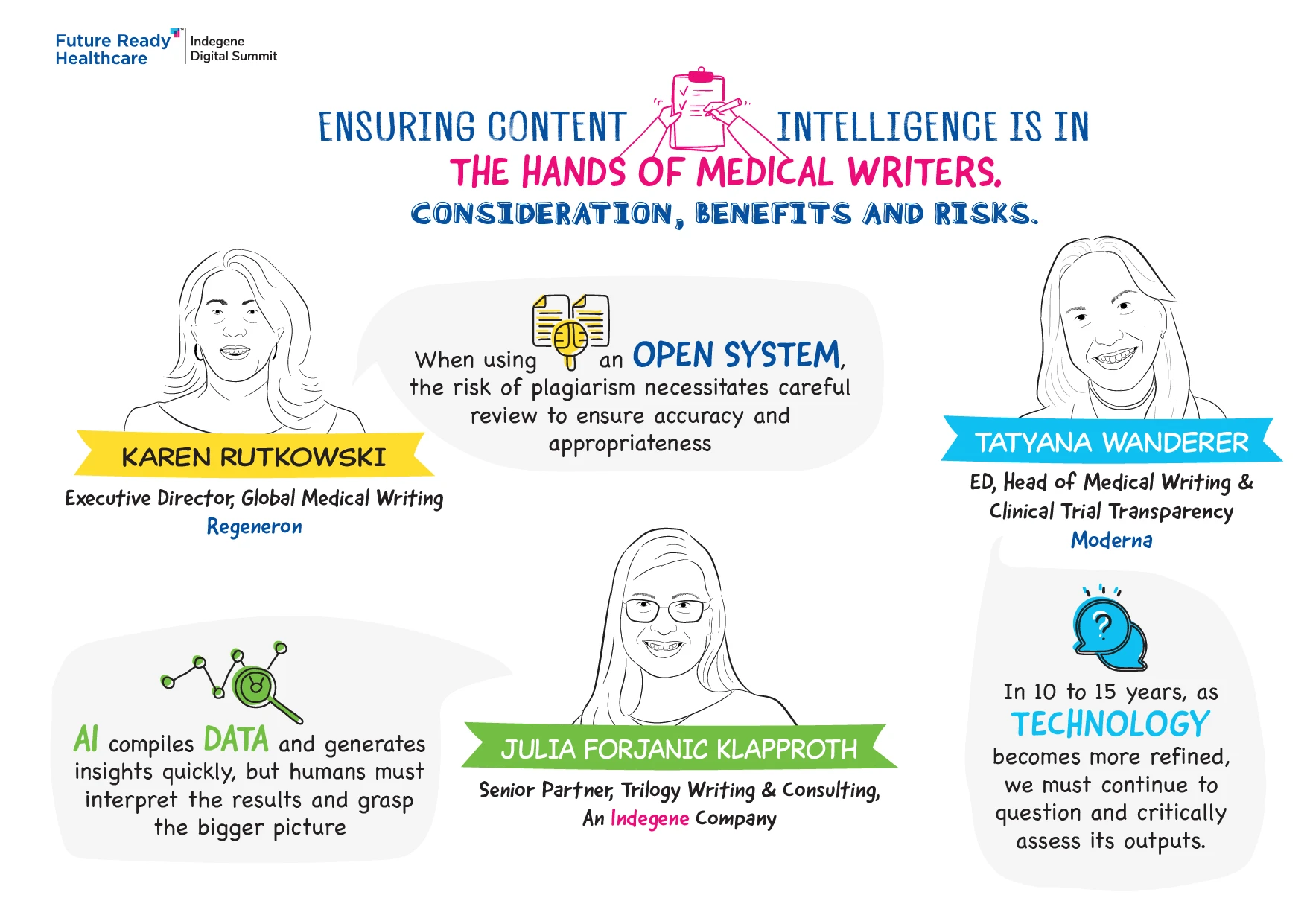
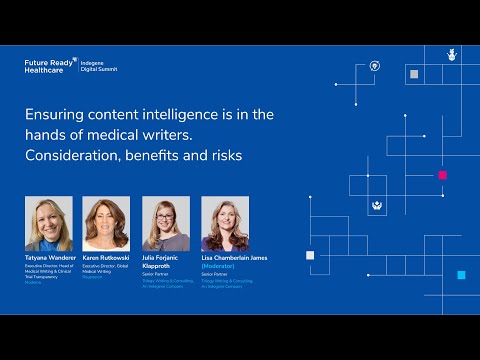
In the rapidly evolving landscape of medical writing, the integration of artificial intelligence (AI) is transforming how regulatory documents are produced. As the pharmaceutical industry seeks greater efficiency and accuracy, AI tools have emerged as powerful allies for medical writers. This blog summarizes insights from a recent discussion held at the Indegene Digital Summit, where industry experts shared their perspectives on the capabilities, limitations, and future of AI in medical writing. The panel featured prominent figures in the field, including Karen Rutkowski, Tatyana Wanderer and Julia Forjanic Klapproth.
Understanding AI in Medical Writing
AI encompasses various technologies, including machine learning, natural language processing (NLP), and generative models like ChatGPT.
Machine Learning (ML):
This allows systems to learn from data and improve over time, helping automate tasks like data extraction and formatting.
Natural Language Processing (NLP):
NLP enables machines to understand and generate human language. In medical writing, it could assist in summarizing documents and translating complex terminology into simpler language.
Generative Models:
Tools like ChatGPT can produce coherent text based on provided input, making them valuable for drafting regulatory documents.
For this panel discussion, AI was defined as any tool that employs automation—encompassing both generative and rule-based elements—to assist in the production of regulatory documents. Karen emphasized the importance of evaluating different tools to enhance the development of regulatory documents, stating, “We've been evaluating different tools, looking for opportunities to enhance the way that we develop our regulatory documents.”
The Power and Limits of AI
Julia highlighted the impressive capabilities of AI in producing regulatory documents, explaining, “AI can pull together all kinds of background information from source documents like protocols, statistical analysis plans, and literature. It can create the methods section of a report, comb through data from statistical outputs, and write meaningful sentences about clinically relevant differences between treatment groups.”
However, Julia also pointed out the limitations of AI, cautioning that it lacks true interpretive abilities. “What it can't do is interpret the data. Even if it's writing sentences that appear to interpret the data, it hasn't because AI doesn't think; it reproduces patterns or follows rules.” This underscores the necessity of human oversight to ensure the accuracy and relevance of AI-generated content.
Tatyana echoed Julia's sentiments, remarking, “Technology is an evolving paradigm. No matter how advanced technology gets, it will not change the relationships between people at work, nor will it change your process.” She emphasized the importance of preparing people and processes to adopt technology effectively.
Karen Rutkowski added an important caution: “When using an open system, the risk of plagiarism necessitates careful review to ensure accuracy and appropriateness.” This highlights the need for human oversight to ensure the accuracy and relevance of AI-generated content.
How AI is Shaping Medical Writing Today
AI tools are increasingly used to support various aspects of medical writing. Julia mentioned her company’s development of an AI tool specifically designed for producing clinical study reports. “The primary tool we're using right now is to produce the clinical study report. It pulls together the methods, takes the data, highlights signals if there are differences between treatment groups, and presents all of that,” she noted.
Karen added that her team leverages AI tools to draft study reports and protocols, explaining, “We're using a closed internal system of ChatGPT for transforming language to suit different audiences and for automating some medical writing tasks.” Karen also emphasized how AI can assist with quality control (QC) processes: “Using tools for format checking, gesture style guides, publication requirements, and publishing requirements will allow the QC team to focus on the important content." She noted that this helps the team prioritize their efforts on more critical aspects of the documents rather than repetitive or mechanical tasks.
Tatyana highlighted AI's role in enhancing processes: “We have a few ChatGPT helpers that assist the writer and the team through the process to ensure that we’ve crossed all the t’s and dotted all the i’s.” She also noted the use of AI for daily tasks, such as creating quarterly reviews and emails.
As AI continues to enhance the processes, its potential extends beyond content creation. For example, tools that aid in document search and summarization are becoming key enablers in helping medical writers quickly retrieve and summarize regulatory and clinical data, allowing for better decision-making and efficiency.
Addressing Challenges and Concerns with AI
Despite the benefits, challenges and concerns surrounding AI in medical writing remain. Julia pointed out the risk of AI-generated content containing inaccuracies or “hallucinations.” “AI can weave in detail that it saw in other contexts that may appear plausible but aren’t real. Every single fact needs to be checked, no matter how minor,” she warned.
Hallucinations occur when AI generates information that seems accurate but is actually incorrect or fabricated. This happens because AI models predict words based on patterns from their training data, sometimes pulling from unrelated sources or misinterpreting context. In medical writing, even small errors can have serious consequences, making human review essential. The main causes of AI hallucinations include:
Lack of Context:
AI doesn't truly understand meaning, leading to misinterpretations.
Data Mismatch:
AI may use irrelevant or outdated information.
Overgeneralization:
AI draws broadly, which can result in inaccurate details.
In a webinar conducted by Indegene last year, panelists discussed major challenges with Gen AI and shared solutions to address them. The panelists highlighted the need for strong quality control frameworks, the importance of ensuring AI transparency and explainability, and implementing data privacy, security, and compliance measures tailored to regulatory requirements. These solutions help mitigate key risks while enhancing the reliability and stability of AI tools in regulatory processes.
Tatyana stressed the importance of maintaining a critical mindset as technology evolves: “As technology becomes more capable, we need to remember this very moment when we said, ‘watch out for this.’ We must continue to critically think about the outputs that we’re seeing.”
Looking Ahead: What’s future of AI in Medical Writing?
Looking ahead, the panelists shared their visions for the future of AI in medical writing. Karen expressed her desire for AI tools to perform cross-document checks to ensure consistency. “Having the ability to, as you're working on one document, cross-check and allow for efficiency across all of your different modules is something that we run out of time for at the end,” she noted. This capability would not only streamline the writing process but also enhance the accuracy and coherence of the final submissions, ensuring that all documents align with each other and meet regulatory standards.
Tatyana added that she envisions AI assisting in the incorporation of comments across documents: “If one of my reviewers made a comment here, I would love AI to say, ‘Hey, there’s similar information in 10 other places. What do you think about changing that?’”
Julia emphasized the importance of transparency and disclosure when using AI tools: “If you’ve used AI, you should disclose it and state how you’ve used it. Transparency is always best.”
Conclusion
The integration of AI in medical writing holds immense potential, but it also brings challenges that need to be addressed. As technology evolves, human oversight remains crucial to ensure the accuracy and relevance of AI-generated content. By preparing people and processes to adopt technology effectively, the industry can harness AI’s power to enhance the production of regulatory documents.
For a deeper dive into the integration of AI in medical writing, Indegene recently hosted another panel discussion titled "Exploring the Intersection of AI and Medical Writing." This session covers the historical evolution of AI in the field, current automation strategies, essential skills for writers, and unique AI use cases. You can watch the full session on demand here.