The Medical, Legal, and Regulatory (MLR) process is critical for life sciences organizations, especially when it comes to reviewing and approving promotional materials, scientific content, and other regulatory submissions. It ensures compliance while keeping up the pace required in getting these materials to market. During the recent Indegene Digital Summit 2024, industry experts gathered to address critical questions such as: How can life sciences organizations streamline their MLR process without compromising compliance? Is it possible to reduce review layers while maintaining quality and regulatory adherence?
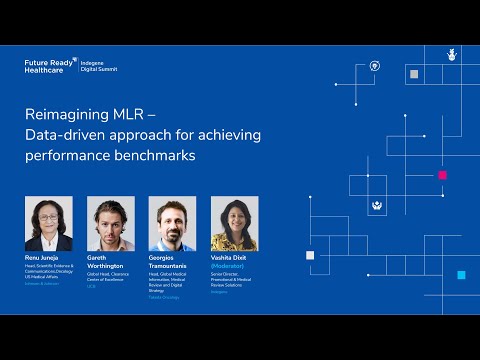
The session explored balancing the need for speed with the demands of regulatory compliance, using technology to enhance efficiency, and rethinking traditional approaches to MLR. Here are the key insights from this engaging discussion.
Streamlining the MLR Process
Many organizations face delays and inefficiencies due to involving multiple levels of review in their processes. One of the panelists Gareth Worthington (Global Head, Clearance Center of Excellence, UCB) suggested,
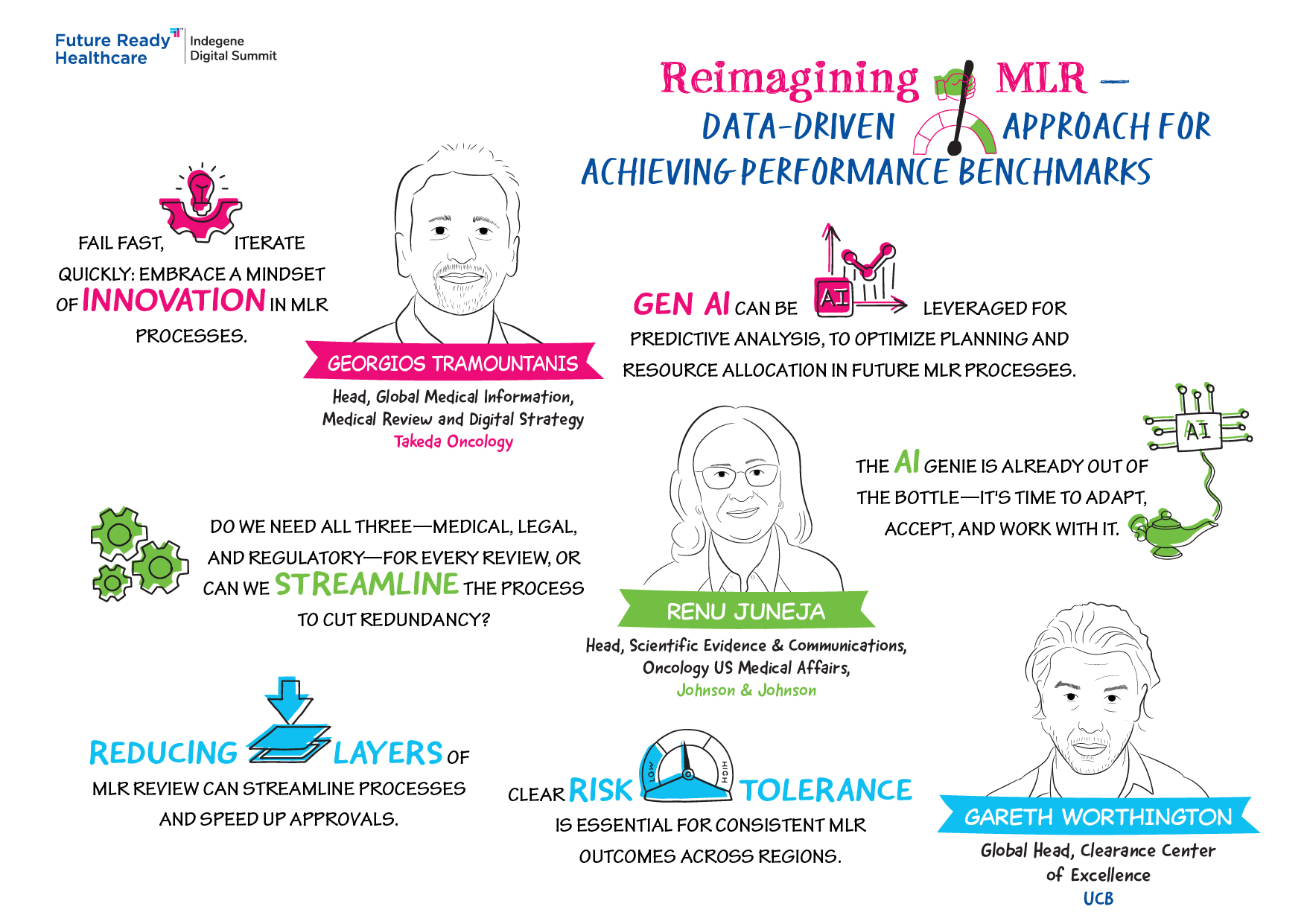
Reducing layers of review and approval ensures your metrics accurately reflect the situation, without being clouded by multiple evaluations.
By reducing non-essential steps, teams can focus on delivering high-quality, compliant materials faster, without sacrificing precision. It allows teams to dedicate more time to critical aspects like aligning with regulatory standards, adapting to market changes, and ensuring that content is both accurate and relevant to their audience. Ultimately, this approach strikes a balance between maintaining rigorous compliance and fostering the agility needed to respond to evolving industry demands.
Another panelist Renu Juneja (Head, Scientific Evidence & Communications, Oncology US Medical Affairs, Johnson & Johnson) brought attention to the complexities posed by regional regulatory differences, asking,
Do we need all three—medical, legal, and regulatory—for every review, or can we streamline the process to reduce redundancy?
This question sparked a broader conversation about the value of tailoring the review process to align with the specific needs of each piece of content, recognizing that not all materials require the same level of scrutiny. By focusing on a more customized approach, teams can avoid bottlenecks and allocate their resources more effectively, ultimately improving the speed and efficiency of the overall MLR process.
Balancing Risk Assessment With Agility
Risk assessment is fundamental to MLR activities, serving as a critical process for evaluating potential issues that may arise during content review and approval. A significant challenge within this framework is enhancing the objectivity of risk assessments to reduce the variability in interpretations that can occur across different teams and regions.
Often, the subjective nature of risk assessment leads to inconsistencies, where different reviewers might evaluate the same content with varying levels of caution. This can slow down the process, create bottlenecks, and result in misalignment between global and local teams. Standardizing risk criteria and making assessments more data-driven could help organizations avoid these pitfalls, ensuring a more consistent and efficient review process across the board.
“Risk assessment is at the heart of the MLR process,” Renu Juneja noted. “Making it more objective can help teams understand and manage risks better”. By refining this assessment process, organizations can foster a clearer understanding of risk levels, enabling teams to make informed decisions and respond proactively to regulatory requirements.
Also, speakers emphasized the importance of aligning all stakeholders on the company’s risk tolerance. “Establishing clear risk tolerance for MLR is vital; differing interpretations can create regional regulatory issues,” Gareth Worthington pointed out. This clarity helps streamline decision-making and ensures that everyone involved in the MLR process is working towards the same goals.
Embracing Technology for MLR Efficiency
The role of technology in optimizing the MLR process was another focal point of the discussion. The speakers highlighted how leveraging tools like Generative AI can aid in predictive analysis, optimizing planning and resource allocation. Industry expert Georgios Tramountanis (Head, Global Medical Information, Medical Review and Digital Strategy, Takeda Oncology) shared their vision:
I envision leveraging GenAI for predictive analysis, to optimize planning and resource allocation in future MLR processes.
Panelist Renu Juneja also noted, “The AI Genie is already out of the bottle—it's time to adapt, accept, and work with it,” indicating that the MLR process must evolve to incorporate AI tools and solutions as they become more integral to the industry. Rather than resisting or delaying the adoption of AI, life sciences organizations should embrace these technologies to enhance efficiency, streamline reviews, and improve accuracy. Integrating AI into the MLR process can help in automating certain aspects like initial content checks, flagging potential compliance issues, and even standardizing risk assessments.
To further streamline reviews, Gareth Worthington shared an innovative solution that MLR teams can implement: “We develop an intent-based review macro with nine questions to identify necessary reviewers, simplifying the process and cutting out unnecessary steps.” This approach not only reduces the time spent in reviews but also ensures that the right people are involved in each step.
Shifting Mindsets: Speed Vs. Perfection
Beyond technology, the session emphasized the critical mindset shifts required within medical affairs teams to balance speed and quality. A common issue is the tendency to strive for perfection before releasing a product, which can result in significant delays. As Georgios Tramountanis highlighted, “We need to change the mindset of releasing a product. If it's 89% ready, release it. It will improve significantly with user feedback.” This perspective encourages teams to prioritize action over endless refinements, enabling them to adapt quickly based on real-world feedback.
Georgios further underscored the value of adopting a "fail fast" mentality.
Fail fast—don’t keep trying to revive something that’s not working.
This approach empowers teams to recognize setbacks quickly, pivot effectively, and focus on what truly drives value. By embracing this mentality, medical affairs can foster a culture of innovation and agility, where learning from early feedback is key to ongoing improvement. This shift in mindset allows teams to move forward with confidence, balancing the need for speed without compromising on quality.
Conclusion
While the session highlighted the evolving landscape of MLR, few crucial aspects that emerged were balancing risk, compliance and speed. By reducing layers of review, embracing technology, and fostering a mindset of agility, organizations can streamline their MLR processes and remain competitive in a rapidly changing environment.
MLR teams must adopt an approach that ensures the process works for them, not the other way around. This mindset is crucial for staying ahead and achieving tangible results and compliance success.
From Promise To Performance.
Trusted by all 20 of the world's top 20 pharmaceutical companies, Indegene helps life sciences organizations accelerate outcomes across the entire value chain.