Pharma has spent decades refining how it reaches healthcare professionals. Yet a new reality is emerging. Physicians are no longer waiting for information to arrive through traditional channels. Increasingly, they are turning to AI-powered clinical decision-support tools at the exact moment a treatment decision needs to be made.
At the Indegene Digital Summit 2026, leaders explored what this shift means for commercial, medical, and development organizations. The discussion highlighted a fundamental transition from push and pull marketing toward intent-based engagement, where evidence, discoverability, and clinical relevance determine whether a brand becomes part of the decision-making process.
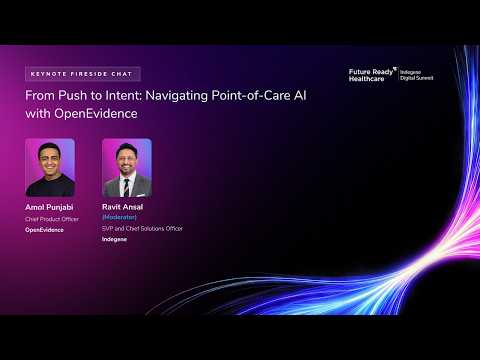
Point-of-Care AI Has Become the New Front Door To Evidence
Physicians today face treatment decisions that rarely mirror the controlled conditions of clinical trials. Real-world patients present with multiple comorbidities, competing therapies, and unique clinical circumstances.
AI allows physicians to synthesize vast amounts of trusted medical literature and apply it to these complex situations in real time. As a result, the first place physicians seek answers is increasingly not a brand website, conference, or representative. It is an AI-enabled evidence platform embedded within their workflow.
Leadership implication: Pharma must recognize that engagement increasingly begins inside clinical decision-making environments rather than traditional promotional channels.
Discoverability Now Matters as Much As Dissemination
Historically, pharmaceutical content was designed for congress presentations, websites, and field-force interactions. AI changes that dynamic.
The discussion highlighted a growing need for organizations to think more expansively about evidence publication. AI systems can synthesize large volumes of information and surface the right evidence when physicians need it most. As a result, the question is no longer simply whether evidence is published, but whether it can be found, understood, and used by AI-powered systems.
The winners will be organizations that treat discoverability as a strategic capability rather than a downstream communications activity.
Leadership implication: Evidence generation and evidence visibility are becoming equally important drivers of commercial impact.
Trust Remains the Currency Of Clinical Decision-Making
Despite rapid advances in AI, the sources physicians trust remain remarkably consistent. Peer-reviewed journals, leading medical conferences, and established clinical guidelines continue to serve as critical signals of credibility.
The conversation pointed to the growing role of trusted evidence sources such as NCCN guidelines in driving physician confidence and adoption. AI may accelerate access to information, but it has not changed the foundations of trust that influence clinical decisions.
This distinction is important. AI changes access, not authority.
Leadership implication: The quality and credibility of evidence remain key determinants of whether information influences treatment decisions.
Better-Informed Physicians Demand A New Engagement Model
One of the most significant shifts discussed was the changing role of field teams. Physicians increasingly arrive at interactions already informed. They may have reviewed AI-generated evidence summaries, explored treatment options independently, or discussed findings with patients who have done their own research. The traditional dynamic of information transfer is rapidly disappearing.
As a result, representatives and MSLs must evolve from information providers into strategic partners who can contextualize evidence, discuss patient outcomes, and support real-world decision-making.
Leadership implication: Future HCP engagement strategies should focus less on delivering information and more on enabling informed clinical conversations.
Closing the Loop Between Development, Medical, And Commercial
Perhaps the most transformative idea from the discussion was the potential to connect evidence generation and evidence utilization more closely than ever before.
AI platforms reveal the questions physicians are asking in real-world practice. Those questions can expose evidence gaps that inform clinical development, guide medical affairs priorities, and shape commercial strategy. Rather than operating through separate silos, organizations have an opportunity to create a continuous evidence loop that connects R&D, medical affairs, and commercial functions.
This marks a shift from viewing AI as another channel to seeing it as a source of enterprise-wide intelligence.
Leadership implication: Organizations that use AI-driven insights to align development, medical, and commercial activities will be better positioned to accelerate evidence adoption and improve patient outcomes.
Measuring Success in An Intent-Based World
As physicians increasingly engage with evidence at the point of care, traditional engagement metrics become less meaningful.
The discussion suggested that future measurement should focus on indicators of learning, evidence adoption, and net-new prescribing behavior rather than legacy channel metrics alone. The most valuable engagement opportunity occurs when a physician is actively making a treatment decision.
Leadership implication: Intent-aware channels require intent-aware measurement frameworks.
Closing Reflection
The discussion reinforced that point-of-care AI is not simply another digital channel. It represents a shift in how physicians discover, evaluate, and apply evidence. As engagement moves closer to the moment of clinical decision-making, pharma must rethink how it generates evidence, disseminates information, measures success, and organizes teams. The future belongs to organizations that move beyond push and pull marketing toward intent-based precision engagement.
