In recent years, particularly accelerated by the COVID-19 pandemic, the relationship between pharmaceutical companies and payers has become crucial for improving patient outcomes, controlling healthcare costs, and driving innovation.
As the industry grapples with the complexities of drug pricing, data integration, and the role of digital technology, there is a growing need for a more collaborative approach.

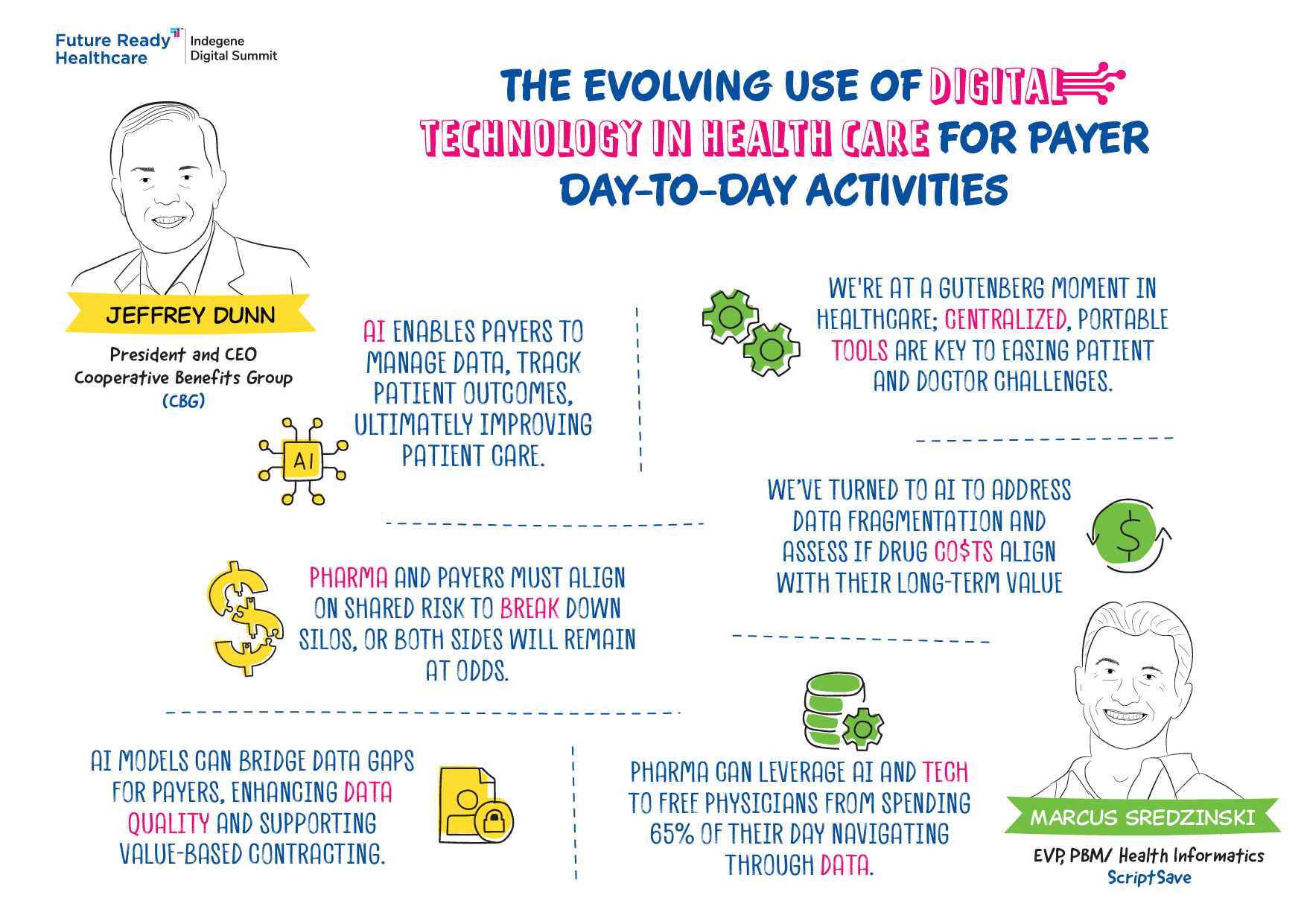
This blog covers insights from a panel discussion at the Indegene Digital Summit 2024, where Jeffrey Dunn, President and CEO of Cooperative Benefits Group, Marcus Sredzinski, Executive Vice President of PBM/Health Informatics at ScriptSave, William Lobb, VP, Pricing, Reimbursement and Market Access, Indegene and Kevin Patterson, VP, PRMA Strategic and New Initiatives, Indegene, discussed how pharma and payers can align better.
They explored four key themes: shared risk models, data integration, digital technology, and pharma’s role in simplifying processes. Below, we dive into how a unified approach could enhance patient outcomes and improve the healthcare ecosystem.
Shared Risk Models: A Path to True Partnership
The healthcare industry is increasingly exploring outcome-based models where payments are tied to the effectiveness of treatments. This shift towards shared risk models holds potential for greater alignment between pharmaceutical companies and payers. In a shared-risk model, payers and pharma work together to ensure that both parties are accountable for the efficacy of treatments. Payers are willing to reimburse for drugs that deliver positive outcomes, but they are seeking assurances that they aren’t bearing the financial burden if a treatment fails to work as expected.
Panelist Jeffrey Dunn articulated this need, emphasizing that while pharma might have access to robust drug data, payers often hold the keys to patient outcomes through claims data.
Can we reach a point where we truly share risk and work together?
he questioned, pointing out that the disconnect between payer data and pharma’s understanding of patient profiles is a hurdle. By sharing insights and aligning on outcomes, both sides can reduce the subjectivity surrounding treatment results and create a clearer path forward for value-based care.
Data Integration & Portability: Breaking Down Silos
One of the biggest challenges facing the healthcare industry is data fragmentation. Payers and pharma often operate in silos, with each managing their own data sets—claims data, drug data, medical records—without comprehensive sharing between stakeholders. This lack of interoperability creates inefficiencies and missed opportunities for better patient care.
Improved data integration and portability could be a game-changer in this space. Improving the flow of information between payers, providers, and pharma can would enable more effective decision-making. When data flows seamlessly, stakeholders can make more informed choices about treatment options, care coordination, and patient management. However, the current reality is far from this ideal. Payers might have access to claims data but integrating it with clinical insights from pharma remains a challenge.
The panel emphasized that technology holds the key to overcoming these barriers. By using advanced data integration solutions and adopting AI for analyzing trends and patient profiles, payers and pharma can work together to deliver more targeted care. Yet, this must be done with due regard for patient privacy and data security, ensuring that the right data reaches the right hands under proper permissions.
Pharma can also play a critical role in advocating for legislative changes that facilitate smoother data sharing across the healthcare ecosystem.
Digital Technology: Redefining Patient Care
The healthcare industry has witnessed a digital transformation in recent years, accelerated by the COVID-19 pandemic. Technologies like Telemedicine, AI, and improved processing power are now central to how care is delivered. These advancements are not only changing patient interactions but also enabling more efficient care models that can reach broader populations.
One key impact of this shift is the rise of hybrid care models, where in-person and virtual consultations are combined to optimize patient access and convenience. These models allow for continuous patient engagement, offering a more seamless experience across different care settings. For example, a patient may begin their care journey with a telehealth consultation, follow up with in-person visits for detailed evaluations, and then monitor their progress remotely through wearable devices.
Digital tools and AI are also playing a critical role in alleviating physician burnout—a significant issue that has been exacerbated by the increasing administrative burden on healthcare providers. AI-powered solutions can automate repetitive tasks, enabling doctors to focus on patient care rather than paperwork. As the panelists noted, unburdening physicians and allowing them to dedicate more time to patient interaction is a crucial step towards improving overall care quality. The challenge, however, lies in integrating these digital solutions into existing healthcare workflows.
Pharma’s Role: Simplifying Processes and Reducing Burden for Payers and Providers
Pharma companies have a unique opportunity to support payers by helping streamline the complexities of care delivery. By working closely with payers, pharma can develop solutions that simplify the administrative processes that often bog down healthcare providers.
As panelist Marcus Sredzinski emphasized,
Pharma can help unburden our physicians, allowing them to focus on the patient rather than administrative tasks
Beyond technology, pharma can also play a role in educating stakeholders about the complexities of drug pricing and healthcare costs. Misaligned incentives among stakeholders—such as brokers, consultants, and providers—often contribute to rising healthcare costs. By collaborating with payers to deliver consistent messages and providing transparency around drug pricing and rebates, pharma can help drive a more unified approach to cost management.
Moving Forward: A Call for True Collaboration
As the session drew to a close, a common theme emerged: a call for a more proactive and authentic partnership between pharma and payers. The challenges discussed—whether they involve shared risk, data portability, or digital integration—cannot be solved by one party alone. It requires a joint effort to create a more sustainable healthcare system that truly puts patients first.
The panelists concluded that while the journey towards better collaboration is complex, it is not impossible. It starts with asking the right questions, embracing transparency, and being willing to let go of legacy practices that no longer serve the industry’s needs. As Jeffrey Dunn noted,
If we don't solve this, it will be solved for us
This sentiment underscores the urgency for pharma and payers to step up and work together, shaping the future of healthcare rather than being shaped by it.