In today’s rapidly evolving pharmaceutical landscape, companies are continuously seeking innovative ways to streamline operations, scale services, and remain competitive. One such approach gaining momentum is the use of Global Capability Centers (GCCs) to scale pharma commercialization services and pharma commercial excellence initiatives. Currently India is home to 36 life sciences’ GCCs with the market poised to expand to $110 billion by 2030, marking a 144% increase. While pharma companies have successfully scaled non-domain-heavy services like IT, finance, and HR in GCCs, expanding domain-heavy functions such as commercial, medical, and scientific services present a unique set of challenges.
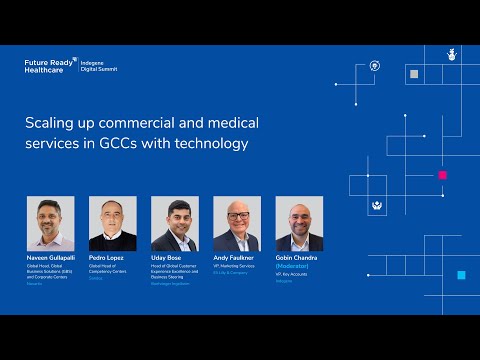
At the Indegene Digital Summit 2024, industry leaders Naveen Gullapalli, Pedro Lopez, Uday Bose, and Andy Faulkner, who have successfully scaled these services within their organizations, explored this topic. They shared valuable insights on the factors driving their success and discussed the complex hurdles that companies must overcome in their pursuit of scaling these essential services.
The key highlights from their session are highlighted below.
The Value of Scaling Commercial and Medical Services Through GCCs
The primary question for any pharmaceutical company considering the use of a Global Capability Center is, why scale commercial and medical services through a GCC ? The answer lies in consolidation, optimization, and the ability to leverage a global talent pool. For multinational pharma companies, consolidating services into a centralized global hub provides a crucial opportunity to streamline operations, standardize processes, and enable digital transformation across the organization.
GCCs offer more than cost savings—they're an opportunity to rebuild with bold, digital-first ambitions.
– Naveen Gullapalli
Beyond streamlining and efficiency, the talent ecosystem in GCCs offers significant value. Pharma companies are increasingly recognizing that GCCs are more than just cost-saving mechanisms. The depth and breadth of expertise available within these hubs provide fertile ground for innovation. In fact, some of the most forward-thinking ideas and initiatives now come from GCCs, a testament to the vibrant talent pool they host.
Moreover, many pharma companies are viewing their GCCs as long-term investments. Setting up a GCC is not just a short-term fix for operational efficiency or cost reduction. Instead, it is an opportunity to secure talent and leadership for the decades to come. Naveen highlighted the importance of a "demographic dividend" when operating in a GCC , noting that the talent in these locations can play a profound role in driving the future success of the organization.
Scaling GCCs isn't just about efficiency—it's about tapping into new ideas and talent from across the globe
– Andy Faulkner
Choosing the Right Location: Strategic Considerations for GCCs
One of the most critical decisions when setting up a Global Capability Center is selecting the ideal location. In the early days, companies often chose locations based on cost-efficiency. However, that approach has evolved. Today, the decision hinges on a broader set of factors including access to specialized talent, digital skills, and geopolitical considerations.
Choosing a GCC location now hinges on digital skills and macroeconomic factors, not just cost efficiency
– Pedro Lopez
The availability of skilled talent in the chosen location is paramount, especially as digital skills become increasingly essential to the success of commercial and medical services. Companies are now looking for hubs where they can access a workforce that is not only cost-effective but also highly skilled in areas like data analytics, AI, and digital marketing. Additionally, changes in the global macroeconomic environment mean that organizations must consider factors beyond talent, such as geopolitical stability and infrastructure, when making location decisions.
A forward-thinking approach to selecting a location is essential, as companies must ensure that their GCCs remain relevant and effective over the long term. It's not just about short-term goals or arbitrage. The real story is about securing talent for the future. This long-term thinking is crucial in a world where talent scarcity, digital transformation, and market competition continue to shape the future of the pharmaceutical industry.
The Importance of Seamless Integration with the Business
One of the key drivers of success when scaling commercial and medical services through GCCs is the operating model. Ensuring that the GCC is fully integrated into the broader business is crucial. Historically, offshore service centres were often viewed as separate, process-oriented entities with limited visibility into the day-to-day realities of the business. However, for a GCC to succeed in scaling domain-heavy services, it must be tightly connected to the core operations of the company.
Successful integration means that the teams within the GCC understand not only the current business challenges but also the future pipeline and strategic goals. In many cases, the GCC teams are better positioned to see the broader ecosystem in which the company operates, offering a perspective that can complement the often-narrower focus of brand teams or asset teams at the headquarters.
The best GCCs grasp business challenges even better than brand teams, offering an ecosystem perspective
– Uday Bose
To achieve this, leading companies are ensuring that their GCC teams are involved from the earliest stages of project development. This means that the teams are not simply brought in to execute tasks at the later stages of a project but are part of the co-creation process. This level of integration allows the GCC teams to fully understand the nuances of the business and enables them to deliver more impactful and innovative solutions.
GCCs must move beyond incremental innovation and reimagine processes with empowered, integrated teams
– Naveen Gullapalli
Managing Change: A Key Success Factor
Scaling domain-heavy services through a GCC is not without its challenges, particularly when it comes to change management. Commercial and medical services are often seen as requiring a personal touch, and many stakeholders are accustomed to working closely with teams in their headquarters. Shifting to a global hub model can therefore require a significant mental and operational shift.
One of the keys to success in managing this transition is phasing. Rather than attempting to move everything to the GCC overnight, companies should map out a roadmap that allows for a gradual transition. Starting with smaller, transactional deliverables can help the GCC team build credibility with stakeholders, while also giving the HQ teams the confidence that the quality of work will not be compromised.
Transitioning to a GCC model requires a mindset shift. Phasing reporting and managing change is crucial
– Andy Faulkner
Pacing the change also allows for deliberate wins early on, which can help to build trust and momentum for larger-scale transitions later. This incremental approach is often the best way to ensure that the transition is smooth and successful in the long run.
Fostering Innovation and Empowering GCC Teams
One of the major advantages of scaling commercial and medical services through GCCs is the potential for innovation. GCCs are often composed of a diverse talent pool that includes individuals from various industries, bringing a wealth of knowledge and best practices that can be applied to the pharmaceutical industry.
However, fostering innovation requires more than just access to talented individuals. Companies must also build a culture of trust and empowerment within the GCC. When GCC teams are fully integrated with the business and empowered to take ownership of projects, they are more likely to come up with innovative solutions that go beyond incremental improvements.
This empowerment often involves giving GCC teams a greater role in decision-making, particularly when it comes to driving innovation. While GCCs have traditionally been limited to task-based innovation, there is growing recognition that they can play a transformative role in reimagining processes and driving enterprise-wide change.
Talent Development and Retention: The Key to Long-Term Success
As with any service center, talent recruitment, development, and retention are critical to the long-term success of a GCC. The highly competitive market for specialized talent means that pharma companies must be strategic in how they build and retain high-performing teams.
Retention in GCCs isn’t just about the work—it’s about connecting talent to the impact on patients and society. That’s powerful
– Uday Bose
One of the best ways to retain talent is to provide meaningful work and growth opportunities. Employees in GCCs who feel that they are contributing to the broader success of the company are more likely to stay and grow within the organization.
Moreover, companies are increasingly focusing on fostering a culture of continuous learning and innovation within their GCCs. This involves not only providing training and development opportunities but also encouraging a sense of belonging and connection to the broader mission of the company. In the pharmaceutical industry, this often means highlighting the impact that the company’s work has on patients and society at large—a powerful motivator for many employees.
The Role of Technology in Scaling GCCs
Finally, technology plays a critical role in enabling GCCs to scale commercial and medical services effectively. From bandwidth considerations to platform access, companies must ensure that their GCCs are equipped with the necessary infrastructure to deliver high-quality services.
A clear vision is vital, but patience is key to letting your GCC team grow and develop expertise
– Pedro Lopez
Technology also opens new opportunities for innovation within GCCs, enabling teams to adopt advanced tools and methodologies that can drive greater efficiency and impact. Whether through data analytics, AI, or digital marketing platforms, the right technology investments can help GCCs not only scale services but also deliver value in new and innovative ways.
Conclusion
Scaling commercial and medical services through GCCs offers pharmaceutical companies a unique opportunity to consolidate operations, leverage global talent, and drive innovation. However, success requires more than just setting up a GCC—it demands careful consideration of location, seamless integration with the business, effective change management, and a focus on talent development and innovation. By addressing these factors strategically, pharma companies can unlock the full potential of their GCCs, driving both operational efficiency and long-term growth.
