The Customer
A leading global biopharmaceutical company focused on developing and commercializing innovative medicines and vaccines wanted to strengthen demand planning for one of its vaccine brands. Their objective was to improve commercial decision-making by understanding how different business levers influenced brand performance across retail and non-retail channels.
This required to build a data-driven commercial analytics framework that could:
- Predict brand performance across retail and non-retail channels
- Quantify the relative impact of commercial and market drivers
- Estimate demand sensitivity through elasticity measurement
- Support scenario-based planning for marketing and sales investments
- Provide GenAI-enabled insights for commercial teams

The Challenges
The organization encountered challenges in translating large volumes of commercial and market data into clear, actionable insights for demand planning.
- Critical commercial drivers were scattered across multiple data sources, including sales execution data, marketing activities, patient refill behavior, national advertising exposure, and consumer market indicators. Without a unified view, it was difficult to understand the factors driving demand.
- Retail and non-retail channels followed different demand patterns and market dynamics. However, the existing approach did not account for these differences, making it difficult to measure how individual drivers influenced performance across channels.
- Many sales and marketing variables were highly correlated, reducing the reliability of traditional regression-based analysis. This made it difficult to isolate and accurately measure the impact of individual commercial and market drivers on demand.
- Business teams needed to evaluate how changes in promotional activities or market access strategies could affect demand before making investment decisions. However, the existing approach offered limited scenario planning capabilities.
- The organization also wanted GenAI-powered insights to uncover hidden patterns in the data and generate meaningful, actionable insights for business teams.
Approach
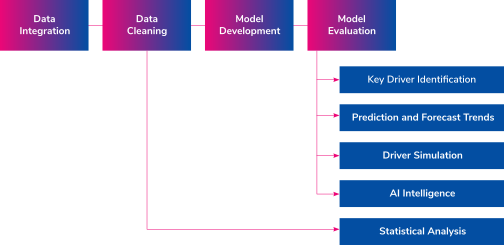
We designed a data-driven commercial analytics framework to quantify key commercial drivers.
Unified Data Creation
We integrated multiple data sources, including sales and marketing activities, customer interactions, account-level attributes, segmentation, advertisement exposure, and external market indicators, to create a unified analytical dataset. Channel-wise sales volume was considered the key dependent variable, linking upstream drivers to business outcomes.
Data Analysis and Feature Engineering
We then combined and normalized both aggregated and granular data for consistency and comparability. Advanced feature engineering techniques, including the creation of time-based and interaction variables were applied while addressing multicollinearity among features.
Descriptive, Statistical, and Machine Learning Methods
Conducted descriptive and statistical analyses during data preparation. Machine learning models were developed to identify business drivers and to analyze prediction trends.
Driver Simulation to Analyze Brand Performance
We then introduced a simulation layer to evaluate brand performance under different marketing scenarios. Adjusted key demand drivers such as promotional efforts, market conditions, and customer interactions to assess their impact on performance. The model allowed teams to evaluate different scenarios and optimize strategy using data-driven insights.
GenAI-Powered Intelligence
We then developed a GenAI-powered interface that allowed stakeholders to query brand performance patterns using natural language. The interface summarized key trends and patterns, identified business drivers, and generated actionable recommendations from complex datasets.
Outcomes
Separate models for retail and non-retail channels improved visibility into channel-specific demand drivers. Elasticity analysis and scenario simulation helped teams assess how changes in promotions, market access, and market conditions could affect demand.
65–70% ↓
Analysis turnaround time compared to conventional analysis.
35-40% ↑
Insight consumption with ~30% reduced dependency on analytical teams
3–3.5x
Decision-making with 85–90% less time spent on impact analysis
The framework is designed to evolve into a strategic decision-support capability. In future, it will enable quarterly scenario planning, optimize channel-level investments, model competitor responses, and continuously refresh models using emerging commercial data sources.
From Promise To Performance.
Trusted by all 20 of the world's top 20 pharmaceutical companies, Indegene helps life sciences organizations accelerate outcomes across the entire value chain.