


Executive Summary
Clinical trial recruitment remains one of the most critical bottlenecks in therapeutic development, with nearly 80% of trials worldwide failing to meet enrolments timelines. Across the industry, clinical trial recruitment strategies increasingly emphasize scalable patient recruitment in clinical trials and long term patient retention in clinical trials as core determinants of development speed and trial success.
This persistent challenge costs the industry billions in delays and compromises patient access to potentially life-saving therapies. Drawing on insights from 100 senior leaders across Biotech/Pharma companies (60%) and CDMO/CRO organizations (40%) spanning the US, EU, and APAC regions, this white paper presents a comprehensive analysis of recruitment priorities, persistent barriers, and transformative solutions reshaping patient enrolments strategies.
Survey Highlights: Insights From 100 Clinical Operations Leaders
1. Oncology Leads Recruitment Focus, Demand for Advanced Eligibility Strategies
Oncology stands out as the dominant therapeutic area in clinical trial recruitment, with 63% of respondents involved in these trials. Its complexity necessitates advanced eligibility strategies to effectively identify suitable patients along with enabling awareness and education for patients and their treating physicians about research as a viable care option Immunology/autoimmune and rare diseases follow as significant areas, highlighting their growing importance. These therapeutic areas require patient-centric trial designs with focused eligibility criteria to optimize recruitment success.
2. CDMOs/CROs Play a Critical Role in Complex Trial Management
Infectious diseases and CNS (Central Nervous System) trials show increased involvement from CDMOs and CROs, reflecting a reliance on external organizations for managing complex trial protocols and operations. These organizations face particular challenges with patient retention and site engagement, emphasizing the need for strategic partnerships and specialized support during trial execution.
3. AI and Predictive Technologies Are Transformative for Recruitment
AI-powered patient matching is recognized as the most transformative innovation, with 73% rating it as the top technology to accelerate recruitment. Predictive enrolment modeling and patient population analytics are also highly valued, providing speed, accuracy, and efficiency in identifying and enrolling eligible patients. These findings reinforce the growing role of AI for patient recruitment as a foundational capability within modern clinical trial recruitment models.
4. Eligibility Criteria and Patient-Centric Engagement Remain Vital
Eligibility criteria remain the most widely used recruitment strategy, highlighting the importance of precise patient selection to improve trial outcomes. Communicating benefits and risks clearly to participants is the most impactful engagement strategy overall, especially among Biotech/Pharma respondents. Patient pre-screening and site-based support enhance recruitment quality, while digital/social media and traditional HCP outreach are considered less effective.
5. Early PRS Involvement and Data-Driven Operational Excellence Are Key
Partnerships with Patient Recruitment Services (PRS) early in the trial lifecycle, particularly post-protocol approval and during site selection deliver significant value by accelerating timelines, accessing diverse populations, and reducing site burden. Data-driven approaches like recruitment forecasting, site relationship management, and patient-centric engagement strategies are highly prioritized for operational excellence. Biotech/Pharma and CDMO/CRO organizations emphasize different aspects of PRS value, underscoring the need for tailored approaches.
From Feasibility to Enrolment: A Data-Driven, Patient-Centric Framework for Modern Clinical Trial Recruitment
Patient Identification and Access
Recruitment challenges are highly therapeutic-area specific. Oncology (63%) leads in recruitment complexity due to biomarker requirements, strict inclusion/exclusion (I/E) criteria, and competitive trial density. Rare diseases and immunology follow, driven by limited patient pools and diagnostic variability. Across all areas, eligibility feasibility (86%) and demographic targeting (75%) emerge as primary determinants of recruitment success. These dynamics underscore why patient recruitment in clinical trials must be designed around real‑world accessibility rather than theoretical prevalence estimates.
Narrow inclusion (65%) and broad exclusion criteria (55%) remain the most significant barriers, with comorbidity exclusions ranked as the most impactful criteria needing reform (40%). The persistent challenge, identified by 54% of respondents, is finding qualified patients who meet all I/E requirements.
Patient-centric recruitment is not only about awareness; it is about feasibility-driven protocol design that expands real-world eligibility while preserving scientific rigor. This approach aligns directly with the principles of patient centric clinical trials, where recruitment strategy begins with protocol design rather than downstream execution. Thus, the recruitment strategy needs to shift from reactive execution to proactive design-stage intervention. According to the survey respondents, high-quality recruitment channels centre on EHR/EMR mining (30%), supported by site-based recruitment (25%) and advocacy partnerships (20%). These findings reinforce that precision identification, reduced protocol friction, and multichannel orchestration are essential to improving both enrolment velocity and retention.
Figure 1: Key criteria for a successful patient recruitment strategy

Sponsors and CROs demonstrate strong alignment around eligibility optimization as the core recruitment determinant. Oncology and rare diseases demand tailored investments, but mid-volume therapeutic areas such as cardiovascular and neurology also require customized feasibility planning due to recruitment variability. Sponsors emphasize protocol-level optimization and portfolio timelines, while CROs highlight operational realities - screen failure rates, site performance, and patient cannibalization. Both segments recognize that overly restrictive criteria directly cause recruitment delays and budget overruns.
Strategically, recruitment excellence requires cross-stakeholder collaboration before protocol lock. Realistic enrolment projections, flexibility in criteria design, and structured site feasibility assessments are critical. Retention strategies must also be embedded early, recognizing that dropout post-screening significantly erodes recruitment ROI.
Data-Driven Recruitment Foundations
Technology integration is redefining feasibility and site performance prediction. Despite patient pool-based site selection, only 11% of respondents report that sites consistently meet enrolment targets, while 41% note inconsistent site performance, highlighting the limitations of static feasibility models. Advanced predictive analytics - combining historical enrolment velocity, screen failure benchmarks, diversity metrics, competing trials, and staffing capacity are required to improve forecasting accuracy. AI-driven eligibility matching and EMR mining reduce screen failures by aligning real-world patient data with protocol criteria. The increasing adoption of AI for patient recruitment is enabling sponsors and CROs to shift from experience based forecasting to evidence based enrolment planning.
Data modeling also supports criteria adjustment simulations, demonstrating the impact of broadening age ranges, reducing comorbidity exclusions, or adjusting symptom thresholds before protocol finalization. The findings confirm that recruitment performance improves when technology is embedded upstream, transforming recruitment from estimation-based planning to evidence-based projection.
Figure 2: Site Enrolment Target Achievement Remains Low Despite Patient Pool-Based Site Selection

Design and Feasibility Stage
The survey highlights that recruitment success is largely determined before site activation. Historical enrolment performance by indication is considered the most valuable real-world evidence input for protocol feasibility, cited by 75% of respondents, closely followed by competitive trial landscape analysis (72%) and patient journey mapping (71%). By embedding these insights early, sponsors can significantly improve both patient recruitment in clinical trials and downstream patient retention in clinical trials by reducing avoidable screen failures and dropout risk.
Together, these inputs sharpen recruitment realism by surfacing risks of patient sharing, operational burden points, and retention vulnerabilities. Even geographic density mapping, ranked lowest at 56%, remains a priority for more than half of respondents, underscoring its continued relevance to recruitment planning.
Figure 3: Most Valued Real-World Evidence Inputs from PRS Partners for Protocol Feasibility

Sponsors expect Patient Recruitment Service partners to translate these data streams into actionable strategies, moving beyond broad awareness campaigns toward protocol-informed recruitment design. By embedding historical performance data, competitive intelligence, patient journey insights, and feasibility simulations early in development, organizations can address the most persistent barrier in clinical trials: the misalignment between protocol ambition and real-world patient accessibility.
Operationalizing Recruitment Excellence: Engagement, Technology, and Execution Synergy
Patient Engagement and Retention
Trust, transparency, and structured site support are the cornerstones of both enrolment quality and retention stability. When it comes to reaching and engaging patients, transparent communication of risks and benefits and patient advocacy outreach are equally the most impactful recruitment drivers, each cited by 25% of respondents. Digital outreach (23%) and personalized engagement materials (20%) further reinforce that patients respond to clarity and tailored messaging.
Yet engagement alone does not guarantee performance. As highlighted earlier, only 11% of sites consistently meet enrolment targets, while 41% achieve only occasional success, exposing execution gaps that awareness-driven campaigns cannot resolve. This gap illustrates that patient retention in clinical trials must be operationalized through proactive site support and pre‑screening pipelines, not addressed reactively after enrolment begins.
Addressing underperformance requires structural intervention: 86% of respondents identify pre-screening support as the most powerful accelerator for underperforming sites, followed by community outreach (67%) and protocol coaching (57%).
Figure 4: Site Support Areas Where PRS Intervention Most Effectively Accelerates Recruitment at Underperforming Sites

At the coordination level, timely feasibility responses and pre-screening coordination are equally critical, cited by 71% of respondents, with patient database access (68%) serving as foundational infrastructure for site readiness. This signals a clear imperative: recruitment strategy must extend beyond communication campaigns into structured qualification workflows. High-performing recruitment ecosystems integrate transparent messaging, advocacy activation, real-time site coordination, and embedded pre-screening pipelines. Such ecosystems represent a defining feature of patient centric clinical trials, where engagement and retention are designed as a continuum rather than isolated activities.
Operational Site and CRO Dynamics
The data highlights that recruitment is a shared accountability model across sponsors, CROs, sites, and PRS vendors. Site unpredictability exposes feasibility optimism gaps, with CROs reporting lower “always meets target” rates than sponsors. This reinforces the need for performance transparency and realistic forecasting. Channel effectiveness confirms EHR/EMR mining (30%) and site-based recruitment (25%) as the highest-quality sources, outperforming digital-only campaigns.
Figure 5: Most Essential CRO and Site Coordinator Activities for Driving PRS Success

Sponsors and CROs primarily engage PRS vendors for patient pre-screening (39%), establishing it as the core complementary service. Campaigns and outreach are supportive, not central, differentiators. Underperforming site acceleration and feasibility responsiveness further underscore that PRS success depends on tight site integration rather than parallel operations. Recruitment excellence requires operational orchestration. PRS vendors must embed within CRO workflows, align incentives with site performance, and provide structured pre-screening pipelines supported by transparent analytics.
Technology-First Positioning - AI and Predictive Innovations
Although protocol optimization tools are valued, predictive modeling and AI-enabled analytics form the strategic core. The future of clinical trial recruitment is predictive and AI-augmented. Hybrid AI-human workflows, privacy-preserving data integration, and dynamic enrolment simulations enable sponsors and CROs to shift from reactive enrolment management to proactive feasibility engineering. AI for patient recruitment is increasingly viewed not as an optimization layer, but as critical infrastructure supporting screening efficiency, protocol fidelity, and enrolment velocity.
AI-driven patient matching is valued primarily for its operational impact. Speed and accuracy in analyzing structured and unstructured patient data rank as the top differentiator (33% Rank 1), closely followed by screening efficiency (31% Rank 1), reflecting a strong expectation that AI will reduce manual workload and accelerate enrolment timelines. Together, these two parameters dominate the top rankings, confirming that the core perceived advantage of AI over traditional methods lies in doing more, faster, with fewer touchpoints. Cost reduction, while acknowledged, ranks lower, suggesting it is viewed as a downstream benefit of efficiency rather than a primary motivator for adoption.
Figure 6: Key Parameters Distinguishing AI-Driven Patient Matching from Traditional Methods in Reducing Recruitment Timelines
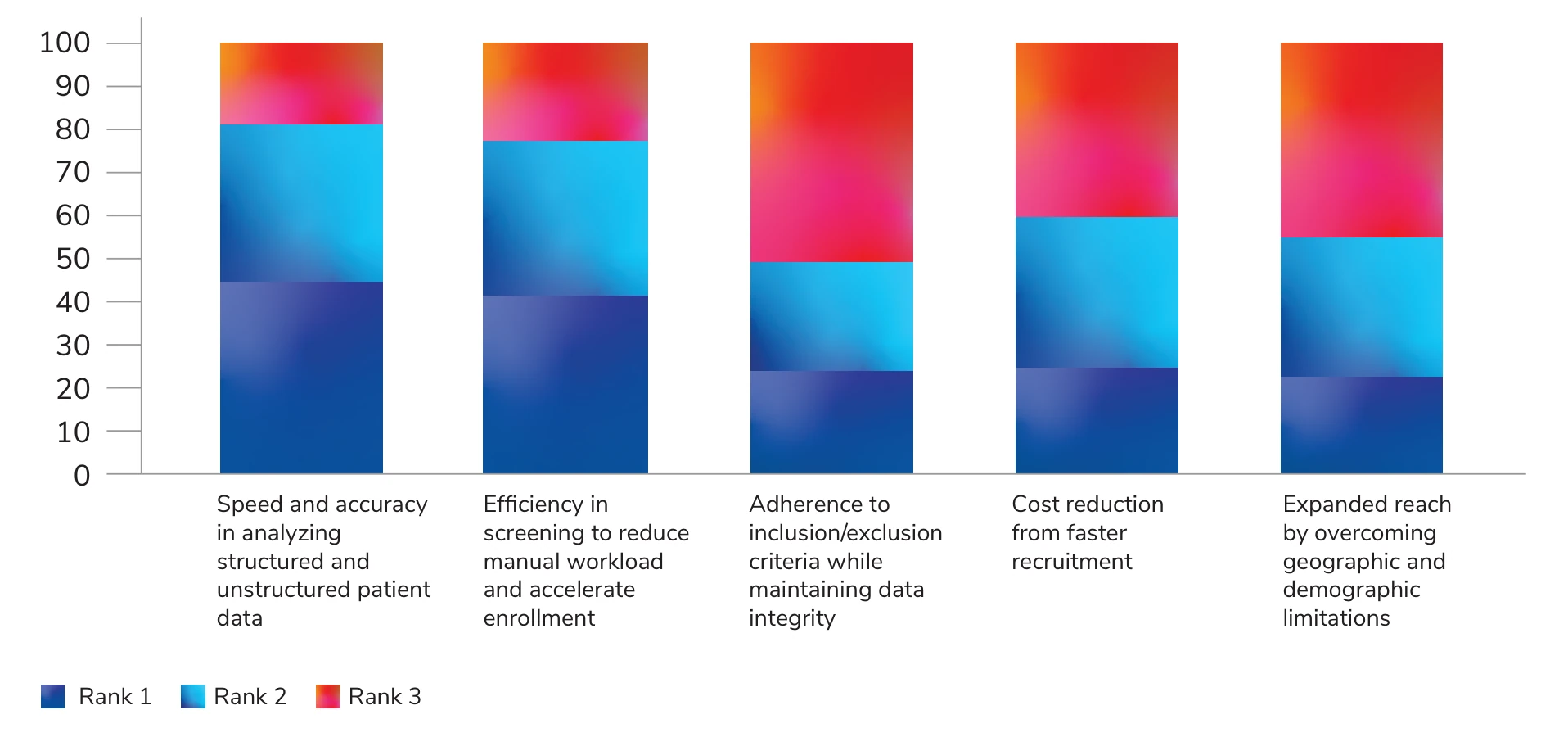
Beyond speed, data integrity and compliance emerge as critical validators. Adherence to inclusion/exclusion criteria records the highest Rank 3 score (32%), indicating that while it may not be the immediate expectation, it is widely recognized as a non-negotiable quality check in AI-driven workflows. Notably, expanded geographic and demographic reach scores the lowest across all ranks, revealing an underappreciation of one of AI's most strategically valuable capabilities in addressing diversity and access challenges in clinical recruitment. This gap presents a clear opportunity for PRS partners to better articulate and demonstrate AI's broader potential beyond operational efficiency.
Activation and Early Recruitment
The survey confirms that the highest ROI from PRS engagement occurs early. PRS value peaks post-protocol approval but pre-site activation (70%) - the optimal window for feasibility refinement, predictive modeling, and early outreach planning. As mentioned in the earlier section, sponsors primarily engage PRS to accelerate enrolment timelines and access diverse populations, reinforcing the role of PRS as a timeline and diversity accelerator. Predictive modeling, EHR mining, and structured pre-screening collectively support this early-phase impact. Early integration of AI for patient recruitment, predictive modeling, and structured pre‑screening significantly strengthens patient recruitment in clinical trials and reduces late‑stage enrolment volatility.
Figure 7: Clinical Trial Recruitment Stages Where PRS Involvement Delivers the Most Value

Given that only 11% of sites consistently meet targets, proactive modeling and integrated activation strategies are essential to prevent downstream recruitment crises. Recruitment strategy must shift upstream. PRS vendors deliver maximum impact when integrated during feasibility, predictive modeling, and activation planning, not after enrolments stalls. Early orchestration of EHR pipelines, AI matching, and structured pre-screening transforms recruitment from reactive remediation to proactive acceleration.
Technology-Powered Partnerships: Redefining PRS (Patient Recruitment Services) Value Across the Recruitment Lifecycle
From Reactive to Predictive: AI and the New Clinical Trial Recruitment Infrastructure
Survey data clearly signals that AI and predictive technologies are transforming the infrastructure of clinical trial recruitment, and the shift is accelerating. AI-driven patient matching is leading the way, demonstrating measurable superiority over traditional manual methods by rapidly parsing structured and unstructured data from EMRs, labs, and clinical notes. These advancements position AI for patient recruitment as a central enabler of scalable, repeatable recruitment performance across global programs. Looking ahead, 51% of respondents cited AI-powered matching as the single most transformative benefit over the next three years, followed by decentralised trial technologies and digital biomarkers.
The data also points to where service providers must build their edge. 40% of respondents identified predictive enrolments modeling as the technology capability most likely to enhance a recruitment provider's value at the clinical trial initiation stage, followed by population analytics and site benchmarking capabilities. Together, these signals reflect a broader strategic shift, from reactive site outreach to proactive, data-driven patient identification.
The implications are significant. AI-enabled eligibility matching, decentralised trial tools, and predictive modeling collectively reduce uncertainty, accelerate screening, and strengthen feasibility confidence. Technology is no longer a differentiator in clinical trial recruitment, it is the structural backbone of modern strategy. The organisations that recognise this early and build accordingly will define the next standard of care in trial execution.
From Vendor to Strategic Partner: How Data, Technology, and Accountability Are Redefining PRS Value
The survey underscores a clear hierarchy of value drivers in patient recruitment, centred on speed, predictability, and measurable outcomes. An overwhelming 84% of respondents engage Patient Recruitment Service (PRS) vendors primarily to accelerate enrolment timelines, followed by 72% seeking access to diverse patient populations. This positions PRS partners not merely as execution resources, but as timeline accelerators and diversity enablers. Critically, the data confirms that PRS impact is strongest post-protocol approval but pre-site activation, a finding that underscores the strategic premium of early integration. When it comes to measuring partnership success, enrolment target achievement ranks first (69%), followed by timeline reduction (64%), cost-effectiveness (58%), and diversity improvement (57%).<br/><br/>
Figure 8: Metrics used by Sponsors to measure a PRS success in supporting clinical trial recruitment

On the data side, expectations are equally high; 80% of respondents expect PRS partners to leverage historical performance data, with competitive landscape analysis (74%) and patient journey mapping (72%) close behind. Yet the data makes one thing clear: technology creates value only when operationalised effectively within sponsor-CRO workflows. AI and predictive tools are necessary, but insufficient on their own. The real differentiator is AI integrated into pre-screening workflows, site coordination, and performance dashboards, with 39% of respondents identifying patient pre-screening as the primary way PRS complements CRO efforts, converting technology into qualified patient pipelines.
Figure 9: Best practices PRS should follow to consistently deliver recruitment excellence

Looking at best practices, 84% of respondents cited data-driven forecasting as the most important capability PRS partners should demonstrate, followed by strong site relationships (77%) and patient-centric engagement (72%). The message is unambiguous: PRS partnerships must evolve from transactional vendor relationships to structured data-sharing alliances. Sponsors and CROs are demanding forecasting accuracy, enrolment accountability, and transparent feasibility insights. The PRS vendors that will define long-term value are those that function as technology translators - converting sponsor data into operational recruitment acceleration, while maintaining rigorous CRO alignment and standardised KPI reporting.
Active Recruitment and Retention
Despite rapid technological advancement, human engagement and site coordination remain the bedrock of sustained recruitment success. Transparent communication and advocacy outreach, each cited by 25% of respondents rank as the top recruitment drivers, reinforcing that trust remains the most reliable gateway to enrolments. Yet the most persistent barrier continues to be finding eligible patients who meet inclusion and exclusion criteria (54%), followed by retention challenges (19%) and site performance variability; challenges that technology alone cannot resolve. Taken together, these findings highlight why patient retention in clinical trials must be addressed as early as feasibility, not deferred to post‑enrolment interventions.
For underperforming sites, pre-screening support emerges as the strongest accelerator, complemented by community outreach and protocol coaching. Operationally, timely feasibility responses and structured pre-screening coordination are essential to maintaining enrolments velocity. Notably, 52% of respondents now recognise retention as a key success metric, a signal that the PRS mandate is expanding well beyond initial enrolments into full lifecycle engagement.
What this reveals is that recruitment excellence demands full-funnel optimization. Technology accelerates patient identification, but execution discipline, spanning transparent engagement, AI-enabled eligibility filtering, site coordination, and retention support is what sustains enrolment momentum from first contact to trial completion. The strongest PRS partners are those who command both: the intelligence to find the right patients, and the operational rigour to keep them.
From Recruitment Tactics to Recruitment Architecture: What the Data Is Telling Us
Recruitment is no longer a downstream execution problem. It is an upstream design challenge. The evolution toward integrated, patient centric clinical trials reflects a broader shift in how sponsors approach clinical trial recruitment as a strategic, cross functional discipline. The future of patient recruitment is not about doing more, it is about designing better. Findings from our patient recruitment survey reveal a clear directional shift: sponsors and CROs are moving away from episodic, reactive recruitment toward integrated, ecosystem-driven models built for speed, diversity, and resilience.
PRS Is No Longer a Vendor Relationship, It Is a Strategic Lever
The case for Patient Recruitment Services (PRS) partnerships has moved well beyond operational convenience. Sponsors and CROs engage PRS partners primarily to accelerate enrolments timelines (84%) and access diverse patient populations (72%), positioning PRS firmly as a speed and diversity multiplier, not simply a resourcing solution.
Timing, however, is everything. Value peaks when PRS is integrated post-protocol approval but pre-site activation (70%), reinforcing that recruitment success is determined long before the first patient is approached. Early ecosystem collaboration, aligning PRS partners with therapeutic strategy, site selection, and protocol design, creates the conditions for enrolments to succeed rather than scramble.
Performance accountability is equally well-defined. Success is measured first by enrolments target achievement (69%), followed by timeline reduction (64%), cost-effectiveness (58%), and diversity delivery (57%). These KPIs reflect a shared accountability model; one where recruitment outcomes are owned collectively across the sponsor, CRO, and PRS ecosystem.
Intelligence Before Execution: The New Planning Standard
Recruitment strategy that relies on assumptions is increasingly indefensible. The survey data is unambiguous: empirical feasibility must ground every planning decision. Sponsors identify historical performance benchmarks (80%), competitive landscape insights (74%), and patient journey mapping (72%) as the most valuable inputs for PRS planning. The same pattern holds for real world evidence-driven protocol optimization, where historical enrolments data (75%) and competitive analysis (72%) top the priority list. The message is consistent, what has happened before is the most reliable guide to what will happen next.
During trial initiation, predictive enrolments modeling (40%) and population analytics (27%) are prioritized to forecast enrolments trajectories and mitigate timeline risk before sites are even activated. Patient pre-screening (39%) remains the primary way PRS complements CRO efforts operationally, translating ecosystem intelligence into qualified, ready-to-engage patient pipelines.
Channel effectiveness data further sharpens execution. EHR/EMR mining (30%) and site-based recruitment (25%) consistently deliver the highest-quality patients, reinforcing the value of data-integrated, site-embedded models over broad, untargeted outreach.
Standardization Is the Foundation That Makes Innovation Scalable
Innovation without standardization produces inconsistency. The next phase of recruitment evolution will not be defined by any single breakthrough technology, it will be defined by how well the ecosystem integrates and governs multiple innovations simultaneously.
Looking ahead, AI-powered patient matching (51%) and decentralized trial technologies (25%) are viewed as the most transformative innovations over the next three years. But realizing their potential requires a standardized operational foundation. Survey respondents identified data-driven forecasting (84%), strong site relationships (77%), and patient-centric engagement (72%) as the foundational pillars of a scalable recruitment ecosystem.
At the site level, pre-screening support (86%) is the strongest accelerator for underperforming sites, complemented by community outreach and protocol coaching. Timely feasibility responses and pre-screening coordination (71%) remain essential to maintaining site-level alignment. Patient engagement anchors everything; transparent communication and advocacy outreach are top recruitment drivers, while persistent eligibility barriers (54%) highlight the continued need for structured feasibility alignment upstream.
Standardized best practices; data-driven forecasting, structured site management, and therapeutic expertise are not constraints on innovation. They are the framework that makes innovation repeatable and excellence consistent.
Conclusion: From Bottleneck to Competitive Advantage: The Recruitment Transformation Is Here
For two decades, clinical trial recruitment has been treated as an operational problem to manage which is a persistent bottleneck that inflated costs, extended timelines, and constrained the pace of therapeutic development. This survey of 100 global industry leaders reframes that narrative decisively. Recruitment is no longer just a challenge to contain. For organizations embracing data-driven, patient-centric, and technology-enabled approaches, it is becoming a genuine source of competitive advantage. By aligning AI for patient recruitment, patient recruitment in clinical trials, and patient retention in clinical trials within a single operating model, leading organizations are redefining how trials are designed, activated, and sustained.
The Cost of Standing Still
The numbers are unambiguous. Every month of recruitment delay costs sponsors between $1 million and $2 million in operational expenses alone; costs that compound across a trial's lifetime. Yet only 11% of sites consistently meet enrolments targets despite patient pool data selection, exposing fundamental gaps in how feasibility has traditionally been assessed and acted upon. These are not isolated inefficiencies. They are systemic signals that the conventional recruitment model has reached its ceiling.
Five Pillars That Define the Next Generation of Recruitment
Organizations closing this gap are not doing so through a single innovation. They are building recruitment architectures grounded in five interconnected pillars.
Eligibility as Strategy
Inclusion and exclusion criteria are no longer fixed protocol constraints, they are design levers. Real-world feasibility analysis is reshaping how sponsors approach eligibility, with 40% prioritizing the reduction of comorbid exclusions and 24% broadening age ranges to reflect how disease presents in the real world. These adjustments directly address the single greatest recruitment challenge: finding qualified patients, cited by 54% of respondents as their top concern.
AI and Analytics as Foundational Capabilities
AI-powered patient matching is no longer an emerging capability, 73% of respondents recognize it as transformative, with 51% ranking it the number one innovation priority. Predictive enrolments modeling (40%) and EHR mining (30%) are being embedded into trial planning as standard infrastructure, not experimental add-ons. The question is no longer whether to deploy these tools, but how deeply to integrate them.
PRS as Strategic Partners, Not Transactional Vendors
The highest-performing organizations engage Patient Recruitment Services partners early; 70% report maximum value when PRS is integrated after protocol approval but before site activation, and 60% recognize value as early as protocol design. Aligning incentives through performance-based contracting anchored to enrolments achievement (69%), diversity delivery (57%), and patient retention (53%) ensures accountability is shared, not transferred.
Multichannel Recruitment Ecosystems
No single channel is sufficient. EHR mining, site-based recruitment, advocacy partnerships, digital campaigns, and HCP outreach must be orchestrated as a unified system. Patient pre-screening has emerged as the number one complement to CRO efforts (39%), consistently delivering 50–70% increases in site throughput. Ecosystem thinking, not channel selection is the differentiator.
Patients at the Centre, Not the End
Transparent communication about risks and benefits ranks as the top patient engagement factor (25%), tied with advocacy partnerships. Sustained engagement through retention support, burden minimization, and community-building is not a courtesy, it is a completion strategy. Success must be measured not just by enrolments speed, but by diversity achieved, patients retained, and satisfaction sustained throughout the trial journey.
The Strategic Imperative
The organizations that will lead the next decade of clinical development are those that treat recruitment not as a downstream execution task, but as an upstream strategic discipline. They will optimize eligibility through real-world evidence. They will deploy AI and predictive analytics as foundational infrastructure. They will partner with PRS providers from protocol design onward. They will orchestrate multichannel ecosystems with precision. And they will place patients, not timelines, at the centre of every decision.
The reward is significant: compressed development timelines, optimized costs, and faster patient access to therapies that can change and save lives. The recruitment transformation is already underway. The question is not whether your organization will be part of it, but whether you will lead it.