

The statistics on learning retention can be alarming if you take them at face value. Research on the forgetting curve shows that within 1 hour, learners forget an average of 50% of the information presented; within 24 hours, they forget an average of 70% of new information; and within a week, they forget up to 90% of what they "learned."1
We put so much time and effort into our training program to ensure that our learners receive the knowledge they need to do their jobs more effectively. We need to assess “How effective is the training and implementation of knowledge if 90% of the knowledge gained is lost to time?” We need to ensure learning retention is the top priority as we create our learning offerings, so we can make sure that long-term goals are realized. For that, we have to take a step back and understand more granularly how our learners gain knowledge, how they recall it, and what we can do to leverage the science of learning to our advantage.1
The Science Behind Learning
Forgetting Curve
The German psychologist Hermann Ebbinghaus was the first to hypothesize and study (in 1885) the now-famous forgetting curve – often referred to as Ebbinghaus' Forgetting Curve. He noticed that at the time of learning, or taking in new information, a learner "knows" 100% of the material. However, the memory of what one learned starts to diminish immediately, and rather rapidly.2
His studies have been replicated much more recently and have come to the same conclusion – memory loss is exponential immediately after a learning event. As you get further away from the learning event in time, more and more of the information you learned is lost.2
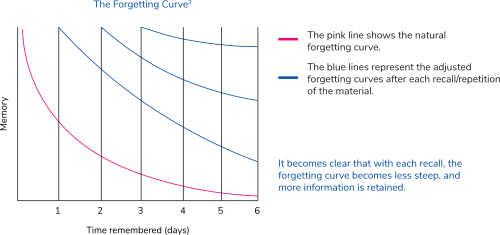
Thankfully, it is not as bleak as it sounds. Ebbinghaus and subsequent researchers have seen that there is a way to combat the natural forgetting curve. Repetition over time and being reexposed to the same material are 2 key strategies that can combat the forgetting curve.3 Repetition of the material at spaced intervals after the learning event changes the trajectory of the curve. At each intervention or repetition, the curve becomes less steep, and the learning is more engrained.3
The "Baby Shark" tune!
Ebbinghaus also discovered a concept called "overlearning." Essentially, if you practice something more than is required to learn it, the information is stored much more strongly, and the effects of the forgetting curve for this information is a much shallower slope; for example, if you have kids, the fact that you could sing "Baby Shark" in your sleep may be a product of overlearning. You were not exposed to it just once, twice, or three times – you probably have heard that song far more than was required to learn it, and I would venture to guess that if asked 10 years from now, you would still be able to recall it.
Not all forgetting curves are the same. Many factors influence the rate of forgetting. The meaningfulness of the information to the learners, how it's represented, and the learners' physiological state (stress levels, sleep pattern, hunger, etc.) impact a forgetting curve greatly. Essentially, what you are remembering and how it is presented to you matters. For instance, if you burn yourself on a wood stove, you probably do not need to touch the stove again the next time because you've forgotten that lesson. It was intense, and you don't need reminding. Ebbinghaus discussed the intensity of our emotions and our attention as the 2 factors that determine how steep the forgetting curve is, however, to ensure we stay focused on the objective of this paper, let's keep the discussion on these factors aside.4
The Ebbinghaus' Forgetting Curve makes a lot of sense when we look at the way our brains learn. When we learn something new, connections are created between neurons in the brain. The more you repeat this learning, the stronger these connections become, making them faster and more efficient. It is similar to walking the same path through dense woods – the first time, it's slow going; as you continue to tread the same path, the path becomes clearer and you can navigate the same path much faster. New learning literally reshapes and rewires your brain, a phenomenon called neuroplasticity.5 When you ask your brain to retrieve the new information, you solidify the connections between the neurons more and more each time, and the information moves from short-term memory (working memory) to long-term memory.6
Learning and Memory 7
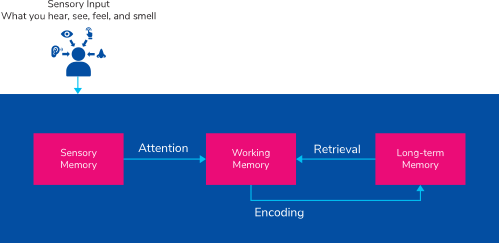
- Sensory inputs enter your sensory memory, but last less than a second. If you do not act, the memory is gone.
- Act on the information to move it into your working memory.
- Retrieve what you already know and work on the new information to associate it with existing knowledge. This will encode new memories, which means you have learned the material.
- You have now learned the material by storing it in your long-term memory. it is available to you the next time you need to learn new material.
In short, you need to be exposed to the learned information a few times, and ask your brain to retrieve the information to move it from short-term memory to long term memory. Long term memory is where we need it to be so that a learner can access the learned information in the flow of work.
DIKW Pyramid
The DIKW Pyramid is a widely accepted model in knowledge management. The pyramid shows how Data (components), Information (processed data into something that is meaningful), and Knowledge (a skill or larger piece of information within a system) are connected to Wisdom, where we add context, judgment, and the ability to see more broadly than the other layers.
The Knowledge Pyramid8
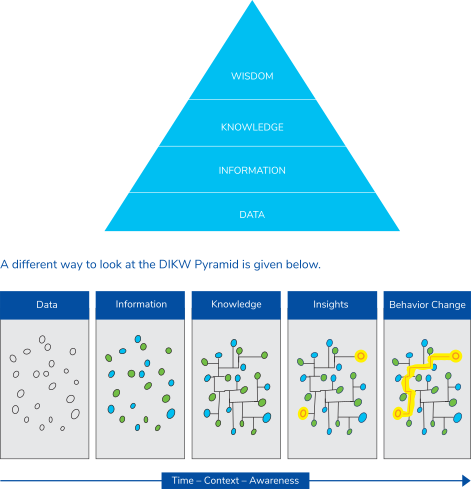
In the first cell, we can see bits of uncategorized things, which aren't very useful. They have no context, and no larger meaning (e.g., random letters). The next cell indicates adding a bit of time and context to the data, and we see that we're able to categorize the data to some extent and it becomes meaningful (e.g., words). Again, as we add context and awareness, we start to see paths and the interconnectivity of the components – and we now have knowledge (e.g., sentences, paragraphs, or a book). For your learners, this would be the ability to pass a test, indicating that they've gained the knowledge you were imparting. They understand the data, and how it fits together. Very often though, that's not good enough for our learners, and we need them to be able to be more strategic to take on the learning in a more holistic manner and do something differently than they did before. For that, we need to add insight and behavior change. In this model, the next level is insight. In this stage, our learners have that "ah-ha" moment and understand what the data should mean to them in their larger schema. They understand how what they have learned could apply more broadly to other areas or draw conclusions about the learned material that was not given to them directly.
The last cell shows behavior change. We see that insight gained is leading to the learner doing something different because of the new information. As learning professionals, this is where we are hoping all our learning leads – a new or adjusted behavior.
The way we move up the pyramid (or across the cells) is by increasing exposure to the content and adding context. We can make connections between new information more easily when we can scaffold it to existing information.
Cognitive load9
It would be remiss to not discuss cognitive load when we are thinking about learning retention. Cognitive load theory came from the understanding that working memory has limited capacity, and therefore when asking a learner to take on new information, we need to be aware of the limitations and work with them instead of against them.
Cognitive load types can be broken down into 3 basic types:
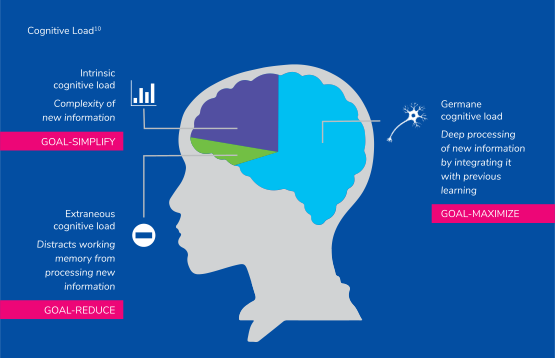
- Intrinsic cognitive load: Complexity of the information. This is at the component level of the learning task – how complex is the task. The intrinsic cognitive load for arithmetic is less than the that of complex calculus. Our goal is to simplify the intrinsic cognitive load.
- Extraneous cognitive load: Noise around the information. This could be anything from poor instructional design to excess information that the learner does not need to distracting background noise. Our goal should be to reduce this load.
- Germane cognitive load: Process of adding the new information into existing schemas – effective learning. This is peak performance for learning, where the new information is laddered in and enmeshed with existing knowledge. We want to maximize this.
Applying Theory to Practical Application
We have covered a lot of the science behind learning retention. Let's discuss what we can do practically to increase learning retention. For that, let's divide this section into 2 major topics: Designing Content With Retention in Mind and Post Learning Event Retention Strategies. Note that this is not an exhaustive list.
Designing Content With Retention in Mind
- Prework that focuses on the "data" and "information" levels of learning is a good example of how you can simplify intrinsic cognitive load. The cognitive load theory suggests that we should look to simplify intrinsic cognitive load. One way to do that is to make sure that learners are already familiar with the "data" level information when we want them to work on higher level learning. For example, we should not introduce new terminology and then use it immediately. It would mean that the learner would need to access the short-term memory of what the term meant and then turn around and try to apply it to a larger schema. That is asking for a lot of effort from the brain and the learner. The learner should first learn and digest the new vocabulary. Once he/she gains mastery of the terms, they should be used in learning something larger.
- Chunk content into small components. Building from the idea that working memory is limited and ensuring that the intrinsic cognitive load is as low as possible, chunking is the act of breaking down content into individual topics or smaller components of related information. Identifying chunks of content that are related, and imparting those chunks first will help create the scaffolding for the new chunks of content you will continue to teach. In addition, limiting each chunk of content to just 2 to 3 main points can ensure that learners remember the information provided.11
- Use varied learning modalities: Using different learning modalities that include options that focus on visual, auditory, or kinesthetic learning allows learners a diverse way to learn. Mixing up the modalities creates more engagement and interest. Ideally, we should try to provide similar pieces of information in different ways so that learners can choose which modality they prefer, for example, a complex scientific process can be explained with the help of a flowchart for the benefit of visual learners. The same process can also be explained in detail by an expert during a podcast discussion, thus benefiting learners who prefer the auditory style.
- Build stories and get emotional. Humans have learned since the dawn of time through stories. The brain is structured to remember narratives. Weaving relevant and compelling stories into your training content will keep learners engaged and help them connect with the information being provided. Storytelling can be impactful for a variety of scenarios such as simplifying complex topics, sensitizing learners on specific issues, converting abstract concepts into relatable information, or even providing a peek into what a normal day might look like on the job. Storytelling also gives you the opportunity to get creative and make your training unique so that it stands out from the crowd.
- Use gamification techniques. The size of the adult gaming industry is a clear indication that gamification principles work. Earning points or unlocking achievements releases serotonin and endorphins, creating engaged and motivated learners. Gamification techniques can vary from elaborate game-based trainings where learners are exposed to particular environments, where they can choose different paths that lead to different consequences, to more simpler approaches such as earning badges on completion and use of leaderboards to encourage healthy competition. An in-built advantage of gamification is that chunking happens naturally in a lot of gamified approaches.12
Post Learning Event Retention Strategies
Make sure that your retrieval practice matches the need.
Not all retrieval is equal. The type of learning that you are trying to encourage should help inform the type of recall you ask of learners. In a recent study, short-answer tasks (targeted retrieval) showed increased retention of directly targeted information, while free-recall tasks (holistic retrieval) helped learners remember a broader spectrum of information.13
Hence, if you want your learners to remember specific pieces of information, short-answer tasks/retrieval practice is the best. In application, it would be asking the learners to produce a particular response that you're looking to "engrain." Mandatory tests with a high pass percentage, verbalizing key topics, completion of worksheets, and other such methodologies can be used for targeted retrieval.
If you're trying to help a learner understand a concept or how the pieces of information fit together, holistic or free-recall tasks are better. These involve asking open-ended questions and longer form recalls. Teach-backs are a good example of holistic/free-recall tasks. Asking learners to teach back what they have learned enables them to explain concepts in own words and understanding. It provides an important opportunity for the trainer to identify gaps and pain points. Interestingly, while these longer free-recall retrievals are harder, most learners tend to be more engaged and motivated to perform well on these types of retrieval tasks.
Use spaced learning concepts (interval retrieval) to hack the forgetting curve.
Thinking back to the forgetting curve, each time we see a piece of information again, the curve became less steep. There has been a lot of research about the best way of putting the learned material before the learner again. How long should the time frame be between each interval? In what format should the information be repeated? There are many schedules that are prescriptive about exactly how and when the material should be put before the learner again. These schedules take into account the type of material, how many times the information has been put before the learner thus far, and whether the learner has demonstrated mastery of the content.14
By combining the principles of personalization of training with spaced retrieval, specific reinforcement of concepts can be provided to each individual learner. This helps us ensure the reinforcement stage of the training is also kept relevant and, in some ways, "unique" for each learner. Spaced retrieval can be achieved by providing bite-sized pieces of materials in the form of videos or job aids on key topics to refresh the learner's memory. Another good example is the use of gamified quizzes with a built-in feature that allows learners to "look up" the correct answer. This ensures that learners revisit the material and in the process of finding the correct answer may also feel inclined to read up any other information that they may have forgotten.
Build on the knowledge the learners have been given.
Workshops (whether face to face or virtual) can help strengthen the connection to the knowledge the learners have been given. Learning is never one-and-done. There is always more to know, and by asking learners to build off of the learning (once it is demonstrated as mastered), you are ensuring that the learning continues to be accessed and thus more deeply engrained. Workshops can facilitate peer discussion and further learning through social learning and reinforcement. They provide an opportunity to teach complex topics and build off of previous learning.
Create opportunities to gain practical experience.
Whether through role-play or creating more in-depth AR/VR-simulated environments, allowing learners to physically practice is an important part of retention. Offer opportunities for learners to verbalize or teach back their new learnings in role-play scenarios. If the content allows, a virtual environment that the learners can manipulate and practice within can help embed learning by having the learners utilize the concepts within a safe space.15
Ensure learners have what they need as they need it.
The phrase "Learning in the flow of work", coined by Josh Bersin, is the new mantra that a majority of companies are trying to adopt.16 We often train people far in advance of the time when they actually have the opportunity to apply the knowledge they have learned. Consequently, by the time they need the knowledge, thanks to the forgetting curve, it is lost! Hence, it is vital to provide learners with topic-based, easily accessible pieces of content that cater to any questions/pain points they have while carrying out their day-to-day jobs. This ensures that the right training is available when there is an actual need for it. Providing resources that enable learners to quickly "refresh" their memories of previously learned material at the exact moment a need arises is essential to reducing the forgetting curve. Carefully curated materials such as videos, job aids, and quick tip sheets that are easily available on demand can facilitate learning in the flow of work, which can improve knowledge retention and increase productivity.
Learn how a top 10 Pharma Company Implemented a Novel Learning Retention Strategy to achieve a 32% boost in learners' knowledge.
References
1. 6 ways to overcome the forgetting curve. Chartwell Content. Accessed September 13, 2021
https://medium.com/@CWContent/6-waysto-overcome-the-forgetting-curve-354151c355c
2. Wittman J. The forgetting curve. Stanislaus State. Accessed September 13, 2021
https://www.csustan.edu/sites/default/files/groups/Writing%20Program/forgetting_curve.pdf
3. Murre JMJ, Dros J. Replication and analysis of Ebbinghaus’ forgetting curve. Accessed September 13, 2021
https://journals.plos.org/plosone/article?id=10.1371/journal.pone.0120644#sec012
4. Shrestha P. Ebbinghaus forgetting curve. Memory. Accessed September 13, 2021
https://www.psychestudy.com/cognitive/memory/ebbinghaus-forgetting-curve
5. Sarrasin JB, Foisy LB, Allaire-Duquette G, Masson S. Understanding your brain to help you learn better. Frontiers. Accessed September 13, 2021
https://kids.frontiersin.org/articles/10.3389/frym.2020.00054
6. Inside the science of memory. Johns Hopkins Medicine. Accessed September 13, 2021
https://www.hopkinsmedicine.org/health/%20wellness-and-prevention/inside-the-science-of-memory
7. Daftardar I. How are memories stored and retrieved? Science ABC. Accessed September 13, 2021
https://www.scienceabc.com/humans/how-are-memory-stored-retrieved-forget-encode-retrieve-hippocampus-long-term-memory-short-term-memory.html
8. Frické M. Knowledge pyramid. ISKO Encyclopedia of Knowledge Organization. Accessed September 13, 2021
https://www.isko.org/cyclo/dikw
9. Klepsch M, Seufert T. Understanding instructional design effects by differentiated measurement of intrinsic, extraneous, and germane cognitive load. Springer Link. Accessed September 13, 2021
https://link.springer.com/article/10.1007/s11251-020-09502-9#Sec1
10. Jamie. The good, the bad and the (can be) ugly: The three parts of cognitive load. McDreemie-musings. Accessed September 13, 2021
https://mcdreeamiemusings.com/blog/2019/10/15/the-good-the-bad-and-the-can-be-ugly-the-three-parts-of-cognitive-load
11. Nesvig B. The power of chunking: how to increase learning retention. Dashe & Thomson. Accessed September 13, 2021
https://www.dashe.com/blog/learning/chunking-memory-retention
12. Is gamification effective: the neuroscience of gamification in online learning. Growth Engineering. Accessed September 13, 2021
https://www.growthengineering.co.uk/the-neuroscience-of-gamification-in-online-learning/
13. Endres T, Kranzdorf L, Schneider V, Renkl A. It matters how to recall – task differences in retrieval practice. Instr Sci. 2020;48:699-728
14. Ho L. How to use spaced repetition to remember what you learn. Lifehack. Accessed September 13, 2021
https://www.lifehack.org/851026/spaced-repetition
15. Brain-based techniques for retention of information. Loma Linda University. Accessed September 13, 2021
https://medicine.llu.edu/academics/resources/brain-based-techniques-retention-information
16. A new paradigm for corporate training: Learning in the flow of work. Josh Bersin. Accessed September 13, 2021
https://joshbersin.com/2018/06/a-new-paradigm-for-corporate-training-learning-in-the-flow-of-work/