The emphasis on AI in clinical development continues to centre around achieving operational excellence, particularly in patient recruitment and clinical data management. The life sciences industry is under increasing pressure to transition to the next phase of digital transformation by identifying practical AI implementations. Industry leaders are investing considerable time and resources into balancing AI's potential with realistic, impactful applications. Beyond these objectives, clinical development leaders are now tasked with generating meaningful insights from a wide array of data sources. This has prompted a vigorous exploration of AI use cases that can enhance data quality , improve clinical trial design, and accelerate the delivery of innovative therapies.
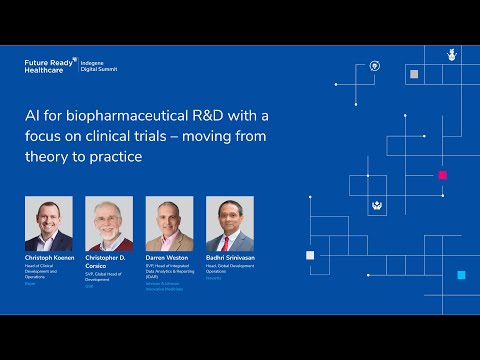
At the Indegene Digital Summit, industry leaders Badhri Srinivasan, Christopher Corsico, Christoph Koenen, and Darren Weston shared valuable insights on how clinical operations leaders can effectively integrate AI into the R&D function without disrupting ongoing efforts. They highlighted key strategies for achieving significant benefits across the clinical development value chain.
Below is a high-level summary of the panelists' perspectives on the current state of AI adoption:
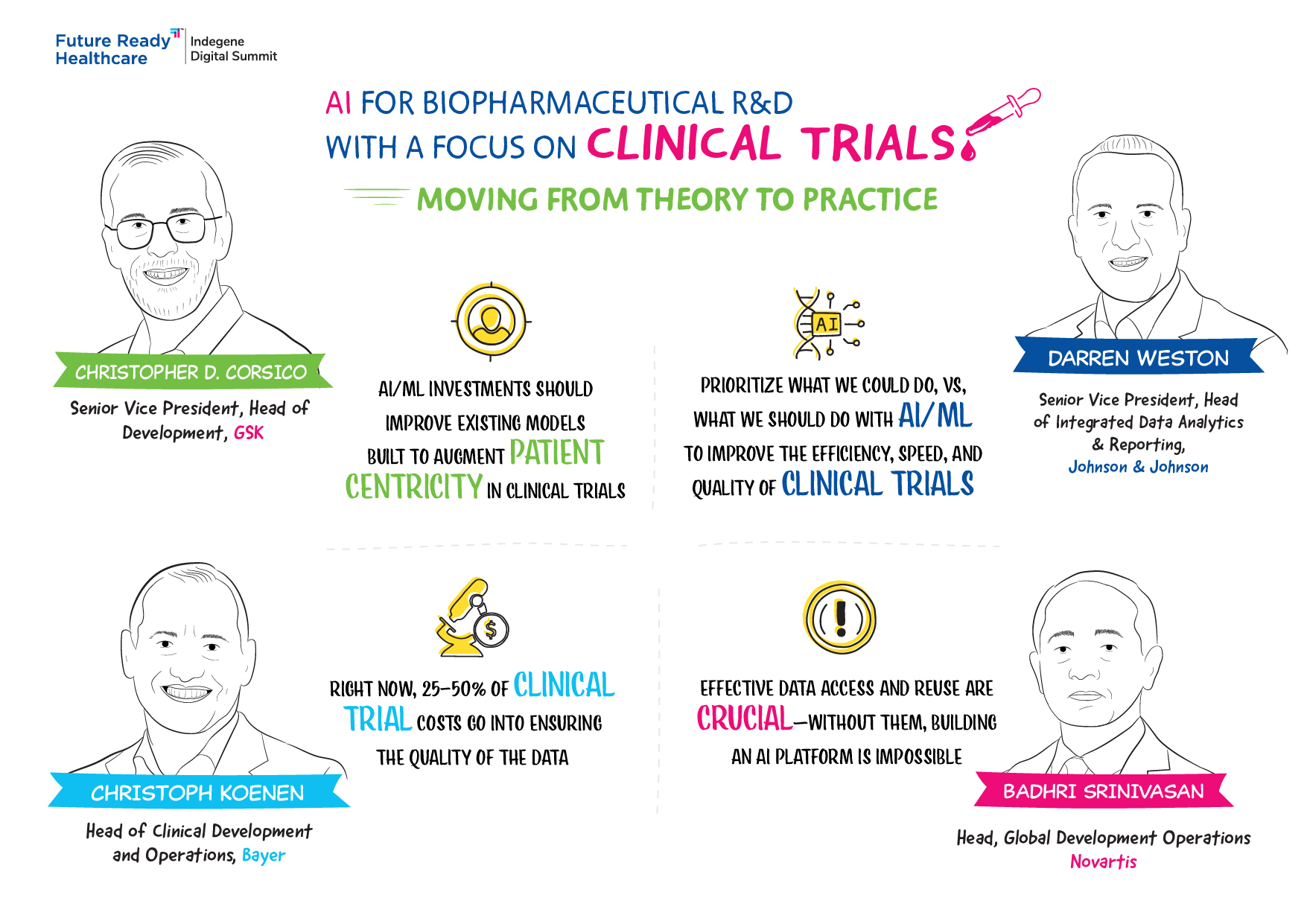
Chris Corsico, SVP and Head of Development at GSK, emphasized the importance of strengthening connected infrastructure and investing in data access and flow. At GSK, AI is used to enhance trial design, reduce patient exposure, and optimize trial sizes. The company is focused on leveraging generative AI (GenAI) to automate documentation and translate complex data into actionable insights, while also generating rich content across the value chain.
Christoph Koenen, Head of Global Development and Clinical Operations at Bayer, identified three core areas where AI plays a critical role: design and planning, conduct, and data quality assurance. AI enables more effective use of real-world data (RWD), remote data collection, and real-time patient contributions. By channeling investments into these areas, leaders can navigate the complex clinical trial landscape and enhance both trial efficiency and data integrity.
Darren Weston, Head of Integrated Data Analytics and Reporting at Johnson & Johnson, discussed the vast opportunities AI presents, as well as the challenges of prioritization within limited budgets. While AI has long been used for centralized data surveillance, Weston noted that GenAI opens up new possibilities—such as creating user-friendly operational dashboards that interpret complex data through natural language queries—allowing broader clinical teams without deep technical expertise to access and utilize this information effectively.
Understanding Patient Populations and Managing the Quality of Data Continue to Be the Focal Points for All Clinical Leaders
The foundation of effective AI integration depends on a robust data infrastructure. The objective of the investment should be to augment the ability to extract up-to-date insights from the latest clinical trial data from all types of sources, seamless data access and reuse existing data to enhance clinical trial design and creation. Along with this, automating content creation and remote data monitoring accelerate study conduct leading to submissions. Most importantly, clinical leaders need to ensure all these initiatives do not disrupt the existing processes in place. For instance, at J&J the team has implemented AI-driven operational dashboards that allow clinical trial teams to query data using plain language, enhancing accessibility for non-technical users. This practical application demonstrates AI's immediate benefits in simplifying data interactions and improving operational transparency. Such practical applications of AI reduce patient exposure and trial sizes without compromising on data quality.
At GSK, we have been looking at ways to use GenAI to automate documents and put them in a different format based on content that already exists
– Chrisopher Corsico
Implementation of AI Initiatives Should Always Depend on the Specific Organization’s R&D Operations and Priorities
The rapidly evolving AI landscape presents life sciences companies with a multitude of opportunities, yet the sheer volume of bespoke and generic offerings from global tech giants and startups can overwhelm clinical leaders. With so many potential applications, there is a risk of investing in AI solutions that may not deliver the expected acceleration in clinical trials. To navigate this complexity, leaders can implement several key initiatives. Establishing a strong governance framework is essential to ensure resources are allocated efficiently, preventing fragmentation across projects. Additionally, fostering connected efforts across R&D helps avoid siloed initiatives that can lead to duplication and inefficiencies. A strategic decision-making process is crucial to determine whether it is more beneficial to build or buy AI solutions, aligning investments with long-term goals. Finally, small, agile teams running pilot projects, such as in silico trials and digital twins, offer an innovative approach to experimenting with AI, ensuring effective adoption and integration in clinical trials. These steps can help leaders maximize the transformative potential of AI in accelerating clinical research.
Understanding the patient population in a contemporary manner is extremely important to find the appropriate power to define the clinical trial design
– Christoph Koenen
Organizational Structures and Regulatory Frameworks are Evolving to Enhance the Reliability and Replicability of AI-generated Data
As the clinical trials landscape evolves, driven by both technological advancements and shifting regulatory frameworks, life sciences companies must adapt by creating new roles that blend traditional pharmaceutical expertise with data science capabilities. Continuous innovation and the need to align with regulatory changes are pushing organizations to rethink their structures. A strategic approach to building the new organizational framework involves triaging emerging technologies and aligning them with core business priorities. This may require the convergence of traditional R&D, medical, and commercial roles with new positions that integrate epidemiology, statistics, IT, and data science, fostering cross-functional collaboration essential for AI’s successful implementation. Companies must also revise their operational setups to accommodate these hybrid roles and create an environment that promotes collaboration across departments, ensuring that AI-driven strategies are fully leveraged.
I think the area where it's a little more challenging to adopt Gen AI, is when we want to create new content, particularly in the R&D space.
– Darren Weston
While there is significant enthusiasm for AI’s potential to reduce costs, accelerate timelines, and improve outcomes in clinical trials, a practical, phased approach to implementation is critical. Regulatory bodies, such as the FDA and EMA, are gradually becoming more open to AI-augmented processes, particularly in areas like patient recruitment, trial monitoring, and data analysis. However, using AI-generated content in regulatory submissions requires rigorous validation to meet evolving standards. Initiatives like the FDA’s Quantitative Medicine Organization demonstrate progress in harmonizing AI innovations with regulatory requirements, but the acceptance of AI-generated regulatory content remains in its early stages. Ongoing validation, careful oversight, and collaboration between regulatory agencies and industry leaders will be key to unlocking AI’s full potential in clinical trial settings.
Conclusion
Across large and emerging life-sciences companies, successful AI adoption in their R&D function requires a strategic approach that prioritizes impactful initiatives, fosters cross-functional collaboration, and adapts organizational structures to support new workflows and job roles. The journey is complex and fraught with challenges, however, the collaborative efforts and shared insights among industry leaders will pave the way for successful AI adoption.
Need help with patient recruitment and data management to accelerate your clinical trials? We’ve got you covered. Write to us and Book your No Obligation consultation with us and let’s talk to kick-start or accelerate your clinical trial enrolment.
From Promise To Performance.
Trusted by all 20 of the world's top 20 pharmaceutical companies, Indegene helps life sciences organizations accelerate outcomes across the entire value chain.