Historically, the pharma commercialization model has been characterized by a largely decentralized construct, with individual brand teams driving most facets of the commercialization process. However, the emergence of centralized digital commercial operations in pharma organizations at global and regional levels has dramatically enhanced brands' ability to engage customers in a more coordinated and efficient manner. As the technology landscape evolves, the next frontier for commercial operations leaders involves leveraging advanced technologies—such as modular content, artificial intelligence (AI), and Generative AI—to introduce greater personalization, respond more swiftly to customer needs, and create value at the moment of necessity.
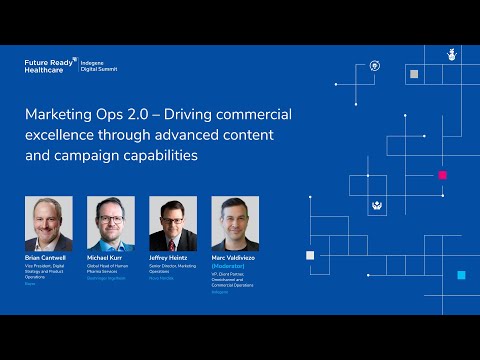
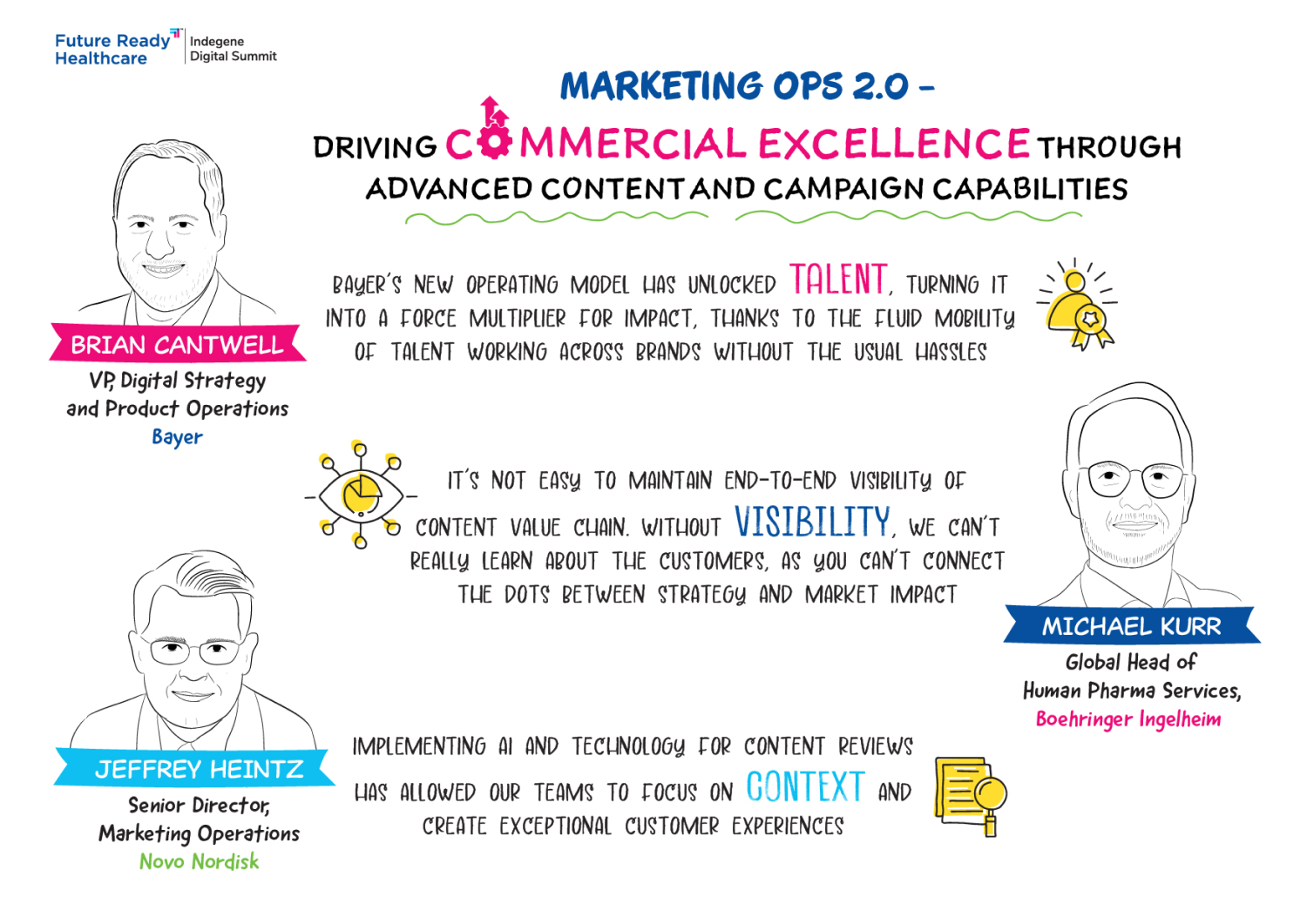
During the Indegene Digital Summit, industry leaders Brian Cantwell, Michael Kurr and Jeffrey Heintz shared their perspectives on how pharma’s commercial operations leaders can elevate their capabilities to achieve a level of sophistication comparable to that seen in other digitally advanced industries.
New Agile-Centric Operating Models in Pharma Commercial Operations
Some companies are adopting operating models aimed at breaking the long-standing silos that exist in pharma organizations. Bayer’s dynamic shared ownership model exemplifies this shift, integrating digital operations with brand teams to meet customer needs. This model brings the advanced capabilities of commercial operations to brand teams seamlessly, allowing digital operations, brand, and potentially Medical Legal Regulatory (MLR) review teams to collaborate more effectively. This integration has enabled faster responses to market needs while eliminating resource negotiation delays that are typically associated with centralized functions serving multiple global brands. Early indicators of success from Bayer’s model show improvements in speed-to-market, driven by its agility. The fluid movement of digital operations talent, a hallmark of this model, is regarded as a force multiplier, allowing brands to access specialized digital talent and capabilities more rapidly. Moreover, with technology advancing at an unprecedented rate, agile ways of working provide a platform for continuous learning, enabling organizations to keep pace with the innovation.
A Cyclical Paradigm Between Centralization and Decentralization of Pharma Commercial Operations
The debate between decentralized and centralized operations remains ongoing. Decentralized models, like Bayer’s, emphasize agility, experimentation, and responsiveness, though concerns about scalability and cost persist. Conversely, centralized operations offer greater cost efficiency, often at the expense of speed and flexibility.
However, the decision between these models is rarely binary. It depends largely on the organization’s size, structure, and immediate priorities. Furthermore, organizational needs often fluctuate, leading to a cyclical shift between centralization and decentralization. What may begin as a decentralized model to foster agility might eventually necessitate a return to centralization as the organization seeks to standardize and scale operations—and vice versa.
Advancing MLR Operations in Pharma with Technology
Regardless of whether operations are centralized or decentralized, MLR remains a critical function for ensuring compliance. However, it is often perceived as a bottleneck in the go-to-market (GTM) process. Leading organizations are addressing this challenge by establishing strong foundations, including accurate tagging and taxonomies, tiered reviews, and leveraging data to track every step in the MLR process. AI is emerging as a tool to alleviate some of the burdens on MLR teams, automating tasks such as content reviews to significantly reduce cycle times. Organizations are exploring AI and other technology-assisted review mechanisms, allowing reviewers to focus on context rather than just being occupied with content reviews. Some pilot programs employing machine-assisted reviews report improvements of up to 50% in subprocesses such as proofreading.
Higher Degree of Global Control Over Content
Centralized commercial operations are increasingly pushing for greater utilization of global content, aiming to drive cost savings and consistency. They strive to increase visibility into the end-to-end content supply chain and minimize the degree of localization, ensuring global brand strategies remain intact while being executed in local markets. This approach allows global MLR teams to approve content for multiple markets, reducing the burden on local teams.
Modular Content as a Foundation for the Future of Generative AI-Authored Content
Modular content in pharma plays a foundational role in global-to-local content strategies. By pre-configuring content and packaging into localized modules, a concept sometimes referred to as “content toolboxes”—complete with claims, visuals, and business rules—pharma companies can significantly reduce the time-to-market of assets. With approximately 80% of content pre-localized, only the remaining 20% requires further adaptation to meet local regulations, accelerating the approval and deployment process. However, modular content’s potential extends beyond its current role. As Generative AI technologies mature, modular content will provide the granular data required to train AI models. This will unlock the ability to produce highly personalized content at scale, positioning companies that invest today in training models with their proprietary data to capitalize on AI-driven capabilities in the near future. As Generative AI-authored content becomes a mainstream reality in the future, organizations that adopt this approach will gain a competitive advantage, not from the AI models themselves—which will be widely available—but from the proprietary data and content that fuel those models.
Campaign-in-a-box: The Emergence of Integrated Omnichannel Engagement in Pharma
Pharma’s traditional customer engagement strategies, often confined by the bounds of annual or biannual brand planning, are now giving way to more dynamic, integrated omnichannel approaches. Advanced capabilities in data insights, content operations, and campaign execution now enable organizations to pilot sophisticated and dynamic omnichannel engagement programs. Machine learning models can now predict customer behavior, triggering rapid responses across multiple channels, including next-best-action recommendations for field teams, targeted media exposure, and personalized communications via email and other platforms. To scale these initiatives across brands and regions, pharma companies must integrate robust data, modular content, agile MLR processes, and streamlined campaign operations. Moreover, the success of integrated omnichannel strategies hinges on non-siloed, cross-functional collaboration that maximizes engagement impact.
From Promise To Performance.
Trusted by all 20 of the world's top 20 pharmaceutical companies, Indegene helps life sciences organizations accelerate outcomes across the entire value chain.