

Since 2010, registered clinical trials have grown over fourfold, but patient recruitment remains a major challenge due to comparatively slower investment in supporting capabilities. Challenges in patient recruitment for clinical trials continue to persist despite technological advances. While pharmaceutical companies (hereafter referred to as sponsors) and clinical research sites have invested in digital capabilities, their adoption is siloed and largely used to solve only tactical challenges. Understanding how to improve patient recruitment in clinical trials has become critical for trial success.
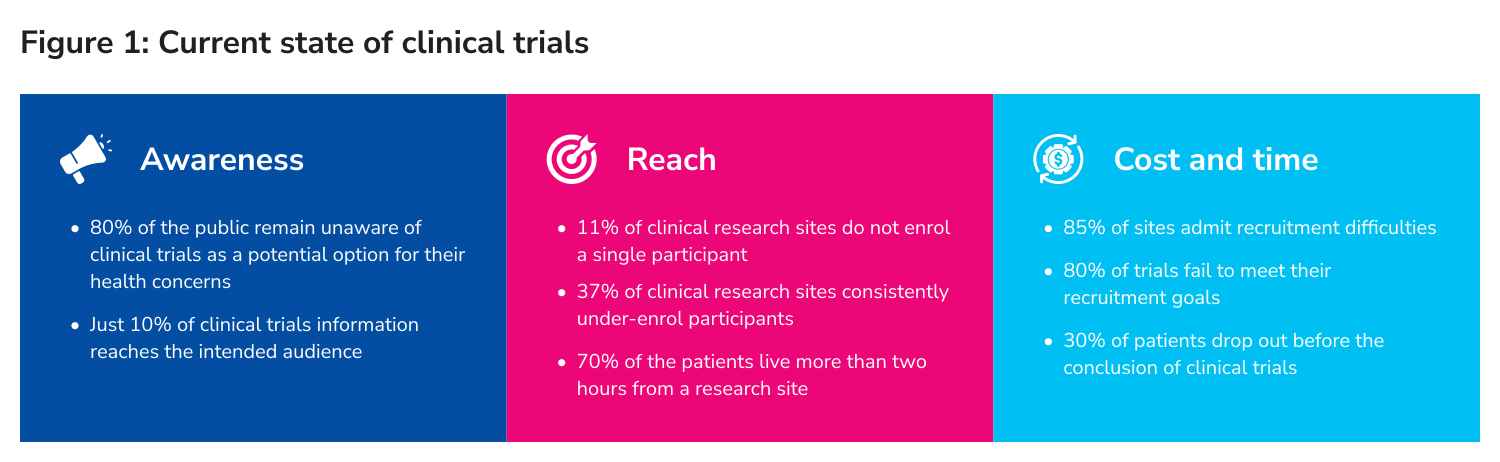
To effectively meet enrolment targets, while ensuring patient centricity, sponsors and specialized patient recruitment companies have adopted a program management approach. This approach helps them align digital tools, processes and resources to improve patient recruitment in clinical trials. Technology driven hybrid recruitment strategies that involve adoption of Real World Data (RWD) sources like Electronic Health Records (EHR) and insurance claims among others, omnichannel marketing, cutting edge technologies and remote monitoring tools also form an integral part of this approach. These clinical trial recruitment strategies have proven effective in addressing recruitment bottlenecks.
The need for Program Management to improve patient recruitment in clinical trials
The Patient Recruitment Program Lifecycle includes program initiation, planning, execution, monitoring, and closeout phases, supported by knowledge management and continuous improvement efforts. With program management, sponsors can adapt to the changing clinical trials landscape and effectively achieve patient enrolment goals in a sustainable manner. Effective clinical trial recruitment strategies require comprehensive program management to ensure success. This helps team members comprehend the study protocol, inclusion/exclusion criteria, study purpose, and therapeutic area at the onset of clinical trials. Further, they can create procedures and leverage technology to synergize various projects related to content, digital strategies, and multi-channel reach that require constant monitoring to ensure alignment and success.
In this approach, as the first step, the Program Manager determines projects and operations that can work together synergistically and creates a Program Strategic Plan outlining timelines, risk assessments, contingency plans, and a work breakdown structure for the program strategies. Patient recruitment solutions must be integrated into this strategic planning phase. In addition, in collaboration with the medical and commercial functions, the program manager organizes comprehensive training sessions for the content, visual, digital marketing, and communication teams to educate them on key aspects such as study protocol and patient persona. These sessions are followed by a brainstorming session where team members share their initial ideas relevant to their area of contribution. Outlined below are the key interdependent clinical trial recruitment strategies that, as part of the program management approach, sponsors can implement, to accelerate patient recruitment.
Create strategic patient mapping and clear, compliant patient communication materials to understand your patients
Utilize Real World Data and train clinical research sites for patient-centric communication
Run digital search ads and social media ads, and implement social media monitoring and listening for more targeted outreach
Educate Registered Nurses (RNs) to enhance patient communications, screenings, and improve enrolment rates
Implement a tailored clinical trial recruitment solution to improve efficiency of the recruitment process
Create strategic patient mapping and clear, compliant patient communication materials to understand your patients
Sponsors can rely on Real World Evidence (RWE) to understand the target patient base and patient behavior to prepare the Patient Persona Document. This document should include demographics such as age, gender, location, education level, and occupation followed by relevant psychographic details like interests, preferences, values, attitudes, behaviors, and idea of their healthcare journey challenges and obstacles. Understanding how to improve patient recruitment in clinical trials starts with comprehensive patient mapping. This document also covers the patient's medical history, previous symptoms, experience with treatments, and other relevant background information that is required to understand the patient's needs, values, and motivations. Along with this, ensure to train each member of your team on patient personas and develop a comprehensive training document that contains all the insights.
Interview or survey potential patients, utilizing online patient forums and communities, social listening, and other reputable sources. Additionally, consult with Healthcare Providers (HCPs) and gather data from reputable online sources, advocacy groups, and investigators in the therapeutic area. Patient registries managed by advocacy groups are also a rich database of participants when looking for clinical trials as they have already reported their disease conditions, which reduces the time required to determine the inclusion criteria. These patient recruitment solutions help overcome traditional screening challenges.
Develop clear and patient-friendly content across the channels that comply with the local and international regulations for patient recruitment for clinical trials. Leverage the expertise of patient advocacy groups and HCPs to prepare patient-friendly material in multiple languages to improve balanced representation of participants. Effective clinical trial recruitment strategies must prioritize regulatory compliance while maintaining patient engagement.
Utilize Real World Data and train clinical research sites for patient-centric communication
As clinical trial sites play an integral role in ensuring patient engagement during clinical trials, it is critical to educate them on enabling patient centricity for ongoing and upcoming studies. For this, sponsors need to ensure that the hospital trial site staff are trained and equipped with the required soft skills and resources to drive patient-centric communication. Initiatives such as implementing feedback loop mechanisms provide better insights to improve patient recruitment in clinical trials, build trust, and improve patient engagement. Along with this, initiatives such as remote monitoring minimize unnecessary visits and procedures for the patients.
Run digital search ads and social media ads, and implement social media monitoring and listening for more targeted outreach
Digital search marketing helps patient recruitment teams efficiently interact, influence and recruit participants for the trial from a larger pool of target patient population. These clinical trial recruitment strategies are essential for sponsors who should invest in these capabilities and partner with technology-enabled patient recruitment companies to execute them. Modern patient recruitment solutions leverage advanced digital technologies to reach broader audiences. These organizations excel in leveraging cutting edge technologies such as Artificial Intelligence (AI) and Machine Learning (ML), and RWD driven hyperlocal multilingual targeted campaigns with well-constructed content for all the relevant platforms such as search engines, social media, online communities and patient advocacy groups. Such clear and concise campaigns not just cost-effectively boost patient recruitment but also provide an accurate summary of information about interested participants to the principal screener, permitting qualified patients to determine their eligibility and examine the possibility of joining the study. Understanding how to improve patient recruitment in clinical trials involves mastering these digital touchpoints. Online discussions also present an opportunity to closely understand patients' needs and fears about the existing line of treatment. Hence sponsors need to include social media monitoring and listening with relevant hashtags and keywords about the disease area being addressed by the clinical trial.
For clinical trials pertaining to rare and ultra-rare diseases, where diagnosis itself may be impaired and inconsistent, HCP communication is highly important as it increases the credibility and trust for the trial participant. Hence, ensure HCPs are informed through frequent updates, are given patient-friendly communication material, and an adequate feedback loop with them is maintained. These actions improve HCPs knowledge and engagement levels, and expedite patient recruitment for clinical trials while addressing challenges in patient recruitment for clinical trials.
Educate Registered Nurses (RNs) to enhance patient communications, screenings, and improve enrolment rates
RNs play an invaluable role in designing the patient trial enrolment experience and improving patient enrolment rates. Most importantly, these nurses exceed the boundaries of merely enrolling patients. They build relationships and earn patients' trust by addressing their concerns, by providing accurate information about the clinical trial process, and by creating a safe and supportive environment for the enrolled individuals. They also monitor potential participants' communications, conduct a secondary screening, and assess patient eligibility for the trial. Hence educating RNs about the clinical trial helps them explain the procedures to the patients, dispel some common fears, and ensure seamless experience for the patients during the clinical trial. This education forms a crucial part of how to improve patient recruitment in clinical trials. Comprehensive patient recruitment solutions must include dedicated RN training programs to maximize enrollment success.
Implement a tailored clinical trial recruitment solution to improve efficiency of the recruitment process
Deploying a bespoke clinical trial recruitment solution helps sponsors to assist, track, synergize and manage the progress of patient recruitment and engagement in clinical trials. For sponsors, the best way to achieve this, is by collaborating with digitally enabled providers who have the healthcare domain expertise and cutting-edge technologies. Advanced patient recruitment solutions provide comprehensive analytics and real-time monitoring capabilities. The reports and analytics from the solution generate key metrics such as source effectiveness, conversion rates, and forecast enrolment timelines. These near real time insights help recruitment teams create and monitor individual patient journeys and experiences, and promptly take the next best action for the given trial that is backed by compelling data. Such patient recruitment solutions are fundamental to overcoming challenges in patient recruitment for clinical trials. Modern clinical trial recruitment strategies rely heavily on data-driven decision-making to optimize outcomes.
Understanding the contribution of each channel to the overall strategy leads to team synergy and recruitment success
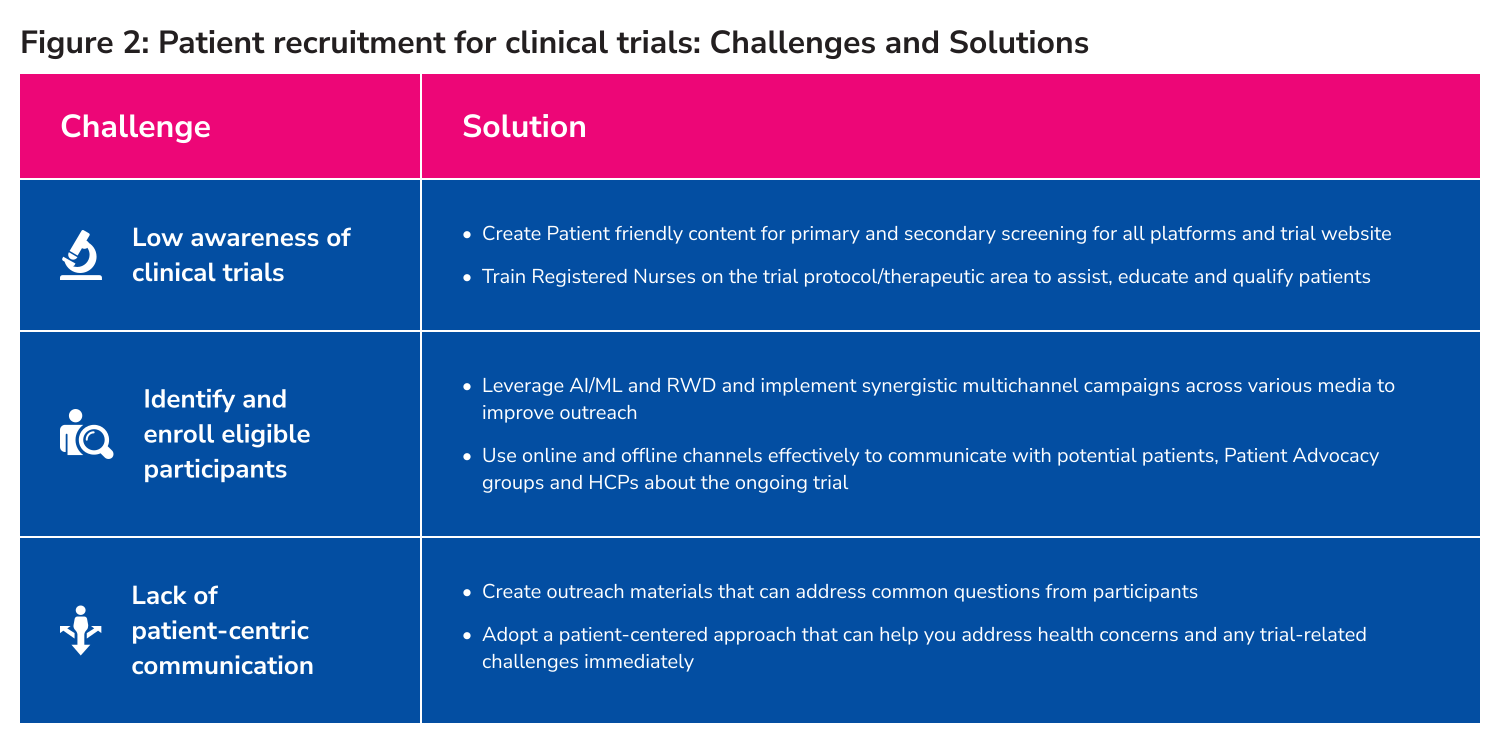
Recruitment methods are more than the sum of their parts. By combining program team synergy, innovation, and strategic approaches, each channel and team member can empower the others. Successful clinical trial recruitment strategies require seamless integration across all channels and stakeholders. Monitoring insights diligently and combining multiple channels like digital outreach, HCP communication, offline promotion, and patient advocacy partnerships can create a synergistic effect, enhancing the impact of each channel. Regular program meetings and consistent communication with relevant stakeholders are crucial for sharing insights and ensuring seamless execution. Effective patient recruitment solutions must facilitate this cross-channel coordination. The goal is to capture and capitalize on the ideas that arise during campaign execution, ensuring that team members understand how each channel contributes to the overall strategy. This understanding of how to improve patient recruitment in clinical trials leads to a perceptible path toward team synergy and better outcomes through effective clinical trial recruitment strategies.
Need help with patient enrolment for your clinical trial? Our comprehensive patient recruitment solutions address the key challenges in patient recruitment for clinical trials. We've got you covered. Write to us and book your no-obligation consultation with us, and let's talk to kick-start or accelerate your trial enrolment using proven clinical trial recruitment strategies.
Sources
From Promise To Performance.
Trusted by all 20 of the world's top 20 pharmaceutical companies, Indegene helps life sciences organizations accelerate outcomes across the entire value chain.