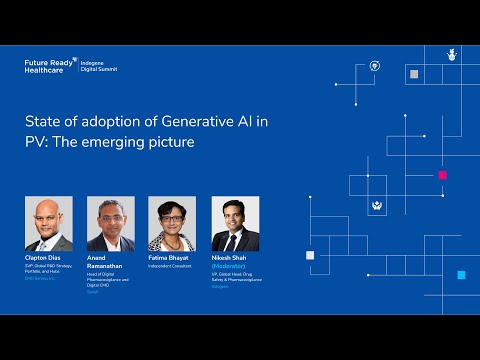
Generative AI has become a buzzword since OpenAI introduced ChatGPT in November 2022. Its rapid emergence has not only garnered attention but also prompted serious consideration of its implications in pharmacovigilance. In a recent panel discussion at the Indegene Digital Summit, industry experts delved into the state of adoption of Generative AI in pharmacovigilance (PV) and explored the emerging trends and challenges. The panel featured distinguished experts, including Anand Ramanathan, Clapton Dias and Dr. Fatima Bhayat.
Where Are We Now With Generative AI Adoption in Pharmacovigilance?
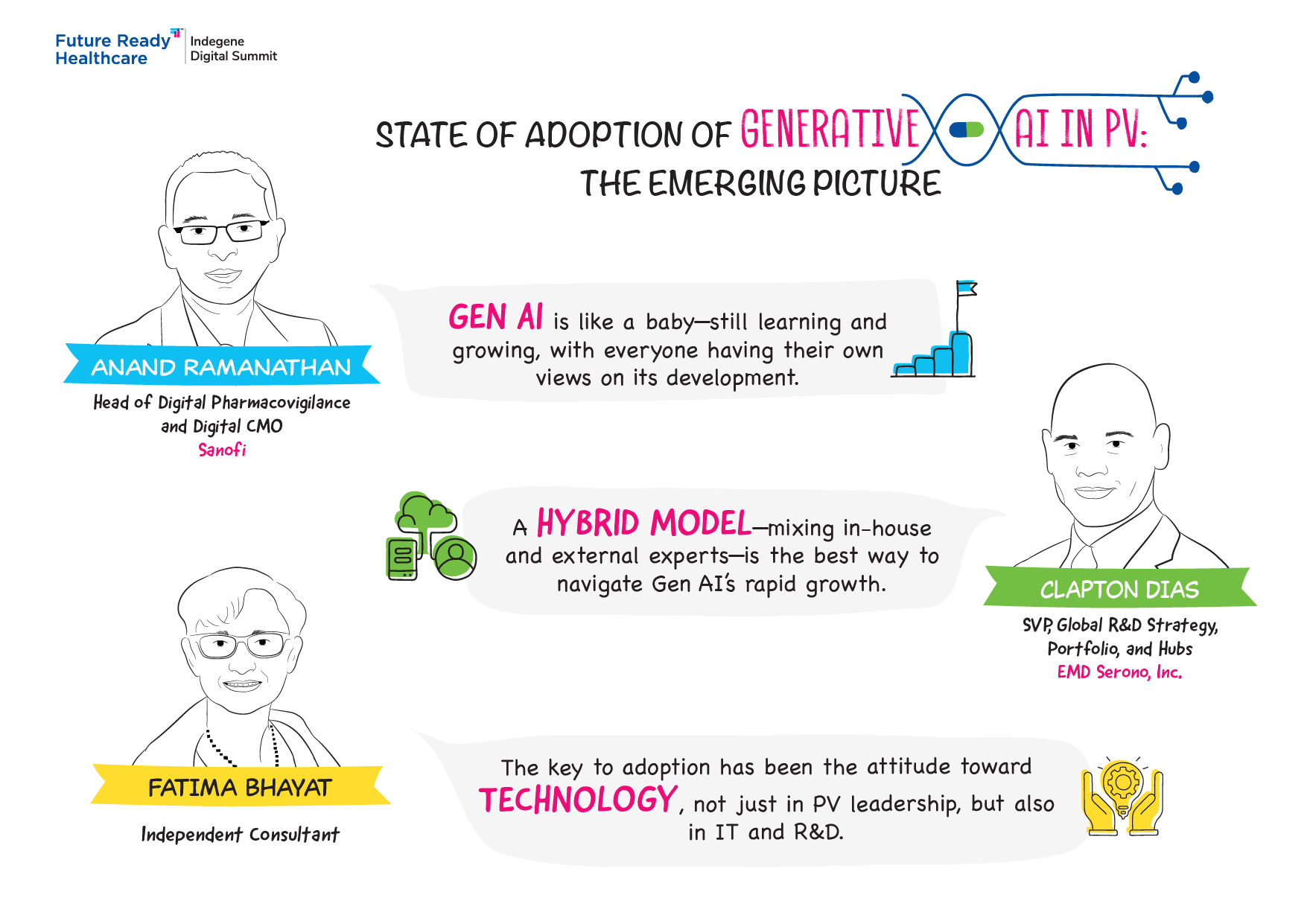
The discussion began with Anand Ramanathan highlighting the initial phases of Generative AI adoption in PV. He noted that while there are many applications across all industries, including R&D and PV, most companies are still navigating the complexities of implementation due to the highly regulated nature of the industry. "There are many different use cases, from creating a summary report to conducting medical assessments," said Anand. However, he emphasized that the overall picture shows companies trying to leverage AI, which is a positive development.
This aligns with findings from the "Shaping the Future of Pharmacovigilance: Industry Trends on Transformation" survey, conducted with 100 PV professionals last year. It revealed that 50% of respondents are experimenting with Generative AI, though full implementation may take 6 months or more. Meanwhile, 27% expect to go live within 6 months, while 7% are early adopters already using the technology. Only 16% had yet to start, highlighting the steady momentum toward AI integration in PV.
Dr. Fatima Bhayat agreed with Anand, stating that numerous organizations are already on the journey of adopting Generative AI. She mentioned that most pilots are being used in cases where pre-existing data, such as text data or data tables, are being reused in multiple documents, like submission packages. "My sense is that most companies have started there, but certainly there are many, many opportunities in PV to use this," she added.
What Innovative Pilot Projects Are Companies Trying Out?
The panelists discussed various pilot projects and use cases where Generative AI is being utilized. Dr. Fatima mentioned that companies are using Generative AI in the generation of PSURs (Periodic Safety Update Reports), DSURs (Development Safety Update Reports), and risk management plans. She noted that most organizations are in the pilot stages and are using submission dossiers for their pilots. Clapton Dias expanded on this by discussing the adoption of Generative AI in R&D. He mentioned that while PV is still emerging in terms of automated reporting and signal detection, other areas of R&D, particularly in drug discovery, are further along. "In terms of drug discovery, Generative AI is further along, especially around molecule creation in both the small molecule and large molecule world," said Clapton.
Last year, Indegene conducted a webinar titled “Unraveling the Potential of Generative AI in Pharmacovigilance.” The webinar explored several high-potential use cases for PV and safety, such as:
Dynamic AE Forms:
Turn static AE forms into adaptive questionnaires tailored to each case
AE Detection:
Identify adverse events and key information from unstructured texts like case reports and transcripts.
Narrative Generation:
Generate dynamic case narratives, replacing static templates
Follow-Up Automation:
Create follow-up letters based on missing data, with tailored questions.
Table-to-Text Conversion:
Convert safety data tables into structured, narrative reports
Signal Detection:
Aggregate insights for better signal detection and presented them for deeper analysis
What Challenges Are We Facing in Implementing Generative AI?
The panelists also addressed the challenges and concerns associated with the adoption of Generative AI in PV. Dr. Fatima highlighted the accuracy of AI-generated content and its acceptability to health authorities as major concerns. She emphasized the importance of maintaining close communication with regulators to ensure alignment. Additionally, she mentioned the cost of implementing and maintaining AI solutions and the potential obsolescence of chosen technologies as significant challenges.
These concerns are echoed in the Pharmacovigilance Digital Council's report, "Advancing Pharmacovigilance Signal Detection with Emerging Technologies." The report found that 50% of respondents identified regulatory acceptance as the top challenge in AI adoption for signal detection, while 33% cited integration with existing systems and 8% expressed concerns about interpretability and data security.
Anand Ramanathan added that ensuring consistent output and the defendability of that output are critical factors, especially in a highly regulated environment like PV. He also discussed the importance of having strong oversight and governance frameworks in place to ensure the proper functioning of AI.
How Leadership Can Make a Difference in AI Adoption?
The attitude towards technology from PV leadership, IT, and the wider R&D organization plays a critical role in the adoption of Generative AI. Dr. Fatima noted that the single most important factor contributing to companies advancing this adoption has been the attitude towards technology, not just from PV leadership but also from the IT organization and the wider R&D organization. "Safety leaders' ability and opportunity to influence the heads of IT and R&D have had a critical impact on progress," she said.
Clapton Dias emphasized the importance of having the right mindset and cultural view towards AI. He mentioned that leadership needs to bring the right mindset and view AI as an assistant technology rather than a replacement. "If you have adoption at the team level and the individual member level in a company, there is going to be an appetite to explore new technologies," he added.
What's Next for Generative AI in Pharmacovigilance?
The potential for Generative AI in PV is vast, with opportunities in literature reviews for signal evaluations, Informed Consent Form (ICF) generation, and other aspects of the drug development process. Dr. Fatima mentioned that literature reviews for signal evaluations are incredibly time-consuming, and Generative AI has a big role to play there. She also highlighted the generation of ICFs and other aspects of the drug development process as opportunities for Generative AI.
Clapton Dias discussed the broader applications of Generative AI in R&D. He mentioned that real-world data from PV studies can be a goldmine for understanding epidemiology, disease progression, and standard of care. "There are a lot of applications that go above and beyond PV, where these data can be very useful," he said.
How Can Organizations Show ROI and Scale Generative AI Effectively?
The panelists also discussed how organizations can demonstrate ROI from Generative AI pilots and address challenges in scaling. Clapton Dias mentioned that starting with low-hanging fruit and understanding the applicability of the technology is crucial. He emphasized the importance of characterizing the current process and identifying where value can be generated through Generative AI. Anand Ramanathan added that the consistency of the output is critical for demonstrating ROI. He mentioned that organizations need to try AI and help AI make the technology work better. "Humans with AI working together will create better outcomes than humans without AI," he said.
Dr. Fatima highlighted the importance of proactive change management in scaling Generative AI solutions. She mentioned that detailed planning of communication across departments and phased implementation across the portfolio are key challenges in scaling.
The Future of Generative AI in Pharmacovigilance
The adoption of Generative AI in pharmacovigilance is still in its early stages, but the potential is vast. While there are challenges and concerns, the opportunities for improving efficiency and decision-making are significant. With the right leadership, organizational support, and proactive change management, Generative AI can revolutionize pharmacovigilance and other areas of R&D.
From Promise To Performance.
Trusted by all 20 of the world's top 20 pharmaceutical companies, Indegene helps life sciences organizations accelerate outcomes across the entire value chain.