As the life sciences industry faces increasing complexities with commercialization and patient care, generative AI emerges as a powerful ally for market success. And while it has been rapidly expanding its use cases within the life sciences industry, it’s initial focus has been primarily on efficiency gains and productivity improvements.
However, its true power lies beyond these applications, with the potential to reshape experiences and explore new frontiers. The shift from viewing AI as a mere productivity tool to recognizing it as a transformative force marks a significant inflection point for the industry. As testament to its transformative potential, HFS Research and Indegene found that 70% of global life sciences enterprise executives are actively investigating or working with GenAI as an enabling technology.
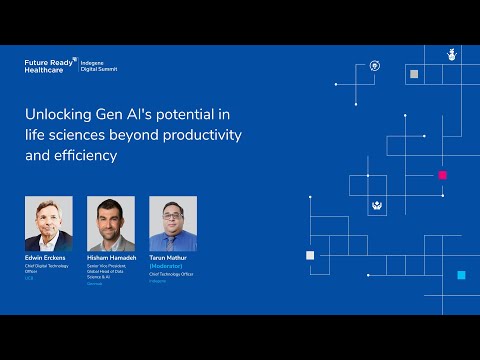
In a deep dive on this topic, Edwin Erckens, Chief Digital Technology Officer at UCB, and Hisham Hamadeh, Senior Vice President and Global Head of Data Science and AI at Genmab, explored these insights with Tarun Mathur, Chief Technology Officer at Indegene, during the Indegene Digital Summit 2024. Key insights from their discussion include:
Long-term ROI and strategic value of Generative AI
Life sciences organizations need to focus on transformational applications of generative AI. For instance, in the area of research and development, UCB leverages generative AI for generating novel therapeutic modules and gaining deeper insights into human causal biology—areas where generative AI provides clear ROI pathways and alignment with business objectives.
Similarly, Genmab’s AI Everywhere initiative enhances antibodies and address new targets using protein language models. Other applications consist accelerating clinical trials through improved site selection and document authoring, including the use of generative AI for creating robust versions of trial-related documents such as narratives, protocols, and clinical study reports.
To accelerate breakthroughs, reduce time-to-market for new therapies, and ultimately improve patient outcomes, life sciences organizations must develop internal frameworks to assess, prioritize, and scale AI initiatives, unlocking its long-term value.
Data foundations and technological challenges
Investing in data infrastructure and governance becomes not just a technical necessity but a strategic imperative. Life sciences organizations harnessing their data assets effectively position themselves better to leverage the full potential of generative AI.
Building a robust data foundation is critical for successfully implementing AI. The urgency to participate in the "new economy" of AI has motivated companies to focus on data quality and accessibility. The increasing volume and diversity of available data, combined with the power of new AI models, enable life sciences organizations to extract meaningful insights at an unprecedented scale. Our new blog post details how can life sciences organizations can harness the capabilities of Gen AI to manage siloed data, streamline search processes, enhance decision-making with unparalleled speed and accuracy, and ensure compliance with global regulations
Focusing on data fosters collaboration and ecosystem-building within the industry, although challenges such as data trust, qualification, and integration of internal and external sources remain significant hurdles. Read about how the integration of Gen AI with CDPs can present a transformative opportunity for life sciences organizations.
Change management and organizational resilience
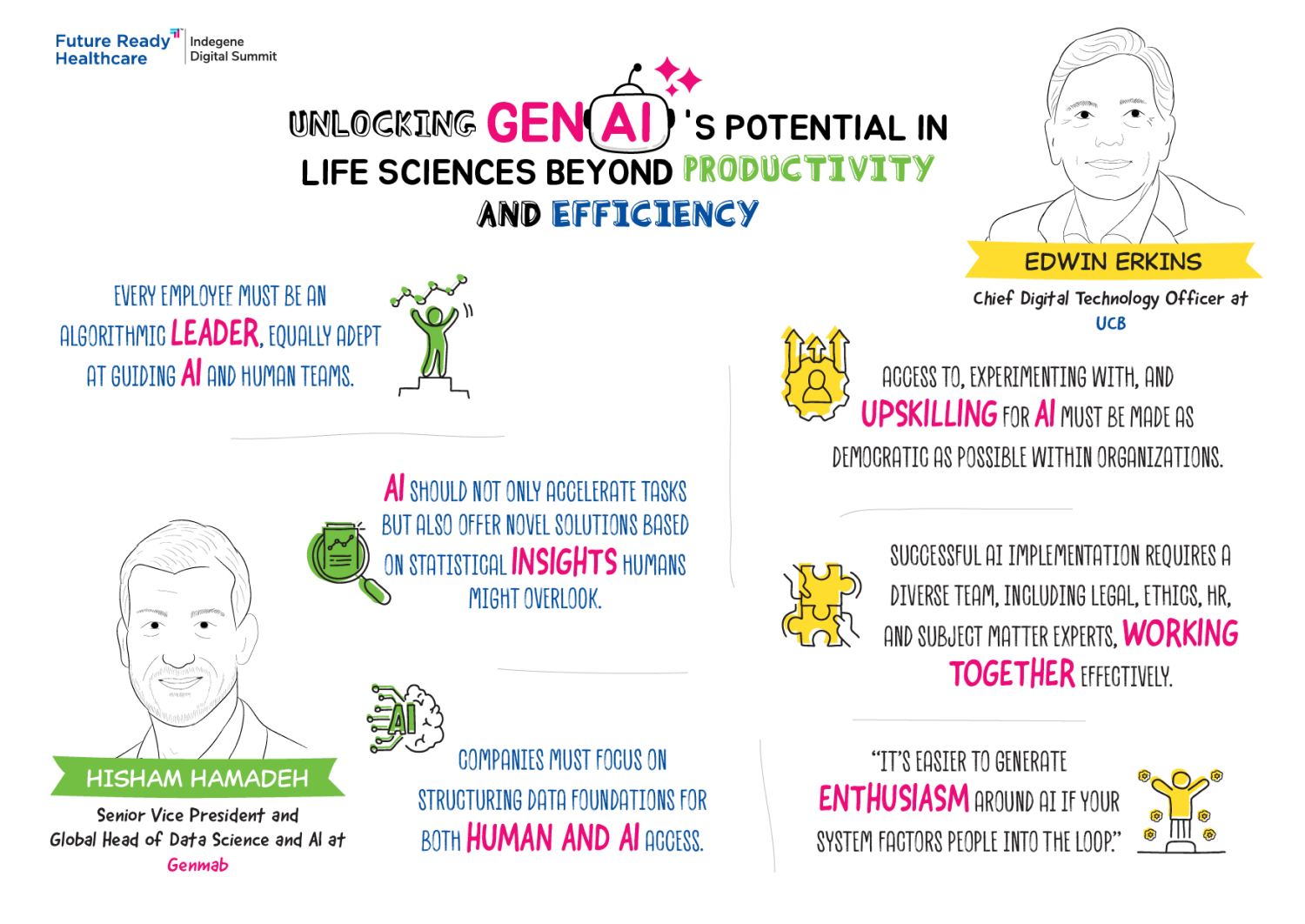
Successfully adopting AI requires more than just technological implementation; it demands a cultural shift. Organizations that foster a culture of continuous learning and experimentation are more likely to succeed in an AI-driven future. As organizations adapt to the AI revolution, change management becomes increasingly critical.
Companies such as UCB and Genmab have established central hubs or labs to facilitate AI adoption across their organizations. For instance, proprietary platforms enable wider Gen AI adoption with standardized user interfaces, making it easy for employees to experiment with and scale AI initiatives. Focusing on a few key areas and doing them well is crucial, with medical writing as an example where Gen AI is expected to be widely adopted.
These internal enabling functions engage employees at all levels—from novices to experienced data scientists—in learning and applying AI technologies. Channeling enthusiasm for AI into priority areas that can deliver meaningful top- and bottom-line benefits is crucial.
The evolution of roles and skills
Investing in upskilling programs and creating environments that encourage cross-functional collaboration are becoming crucial to success. The skills and roles required in the new, AI-driven life sciences landscape are shifting significantly. It is no surprise that, according to research by BCG, only 55% of pharma companies report having the data maturity and expertise needed to build meaningful GenAI capabilities in the short term.
New graduates often possess a combination of domain knowledge (e.g., biology) and coding skills, making them well-suited for evolving industry needs.
Successful AI initiatives also now require collaboration across multiple disciplines, including legal, ethics, HR, and subject matter experts. These projects are now "team sports," requiring a much more integrated approach compared to digital transformation initiatives from 5-10 years ago.
Emphasizing individual responsibility in upskilling and adapting to new technologies is also important. Every employee will need to become an "algorithmic leader," comfortable with leading both AI agents and human teams.
Looking ahead: The future of AI in life sciences
As the industry moves towards an AI-augmented future, organizations that effectively blend human expertise with AI capabilities will be best positioned to lead the next wave of life sciences breakthroughs. Generative AI is seen as just one tool in a broader technological ecosystem where success lies in combining various technologies, traditional AI methods, and new collaborative approaches.
Professionals in the industry must upskill and engage with AI technologies at an individual level rather than waiting for organizational directives. Encouraging active participation in the AI revolution involves dispelling hype through practical applications and reimagining how work is conceptualized and accomplished. The journey ahead is positive despite cautious adoption approaches. However, the pace of innovation is accelerating, and the frameworks outlined in this session provide valuable guidance for planning and thinking about the direction of AI in life sciences.
As the life sciences industry continues to explore generative AI's potential beyond simple productivity gains, focusing on transformational use cases, building robust data foundations, and fostering a culture of continuous learning will unlock new possibilities in research, development, and patient care. To learn more about applying GenAI in your life sciences organization or team, read HFS Research and Indegene’s new Gen AI playbook for life sciences, complete with insights and frameworks to help you organize and optimize your Gen AI journey.
From Promise To Performance.
Trusted by all 20 of the world's top 20 pharmaceutical companies, Indegene helps life sciences organizations accelerate outcomes across the entire value chain.