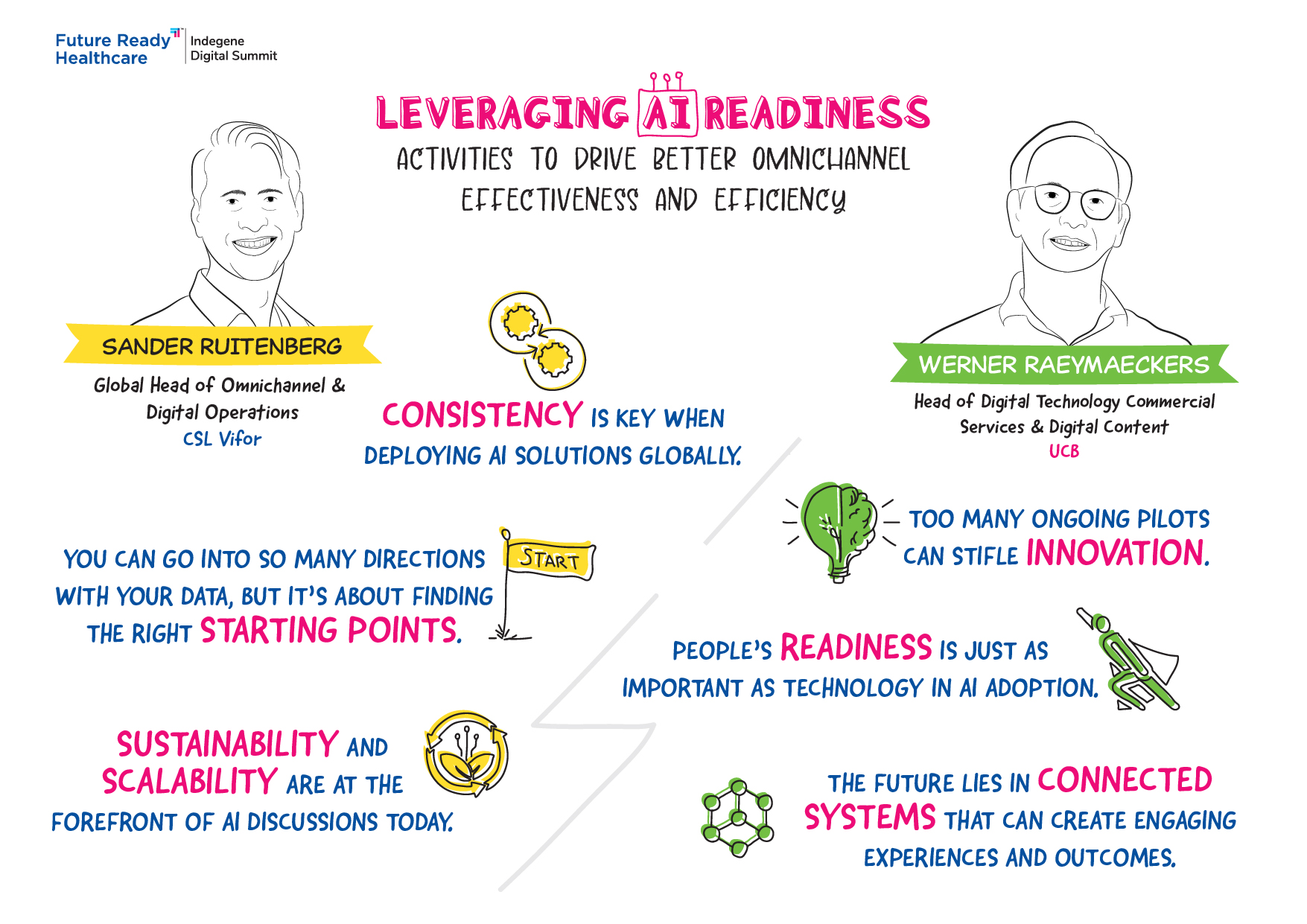
Artificial intelligence (AI) is transforming the life sciences sector, particularly in omnichannel engagement. At the Indegene Digital Summit 2024, industry experts, Sander Ruitenberg, the Global Head of Omni Channel and Digital at CSL Vifor and Werner Raeymaeckers, the head of Digital Technology and Commercial Services at UCB, discussed how AI readiness is driving efficiency and effectiveness within organizations.
Highlighted below are the key insights from their session on leveraging AI in life sciences to optimize omnichannel strategies, focusing on data management, prioritizing use cases, and the role of people in the AI journey.
The AI-Driven Shift in Life Sciences
The life sciences industry has been working towards standardization and consistency in omnichannel engagement for years, but AI has significantly accelerated progress. AI’s evolution has pushed organizations to reassess their capabilities and processes, driving the adoption of new standards and approaches that have long been sought after. This unexpected side effect of AI readiness is helping companies streamline operations and improve customer engagement.
AI is not just about new technology; it is also about ensuring that the entire organization is ready to embrace it. Many companies are finding that their efforts to prepare for AI are having a knock-on effect, enhancing overall operational capabilities and creating better customer experiences.
Reinventing Data and Technology
As AI in pharma is highly dependent on data, organizations must revisit their data management strategies to fully harness AI’s potential. Many companies are focused on streamlining taxonomies and workflows to ensure consistency across different markets. By standardizing their data processes, organizations can more effectively deploy AI solutions on a global scale, reducing fragmentation and improving efficiency.
We've spent the last two years streamlining the simple taxonomies and workflows in our systems to make sure that when we deploy these solutions more holistically and centrally
Consistency is key to maintaining viable, scalable AI applications across an organization.
One key approach involves reassessing internal data landscapes to build robust data analytics programs. Companies are investing in long-term roadmaps that balance organizational readiness with data capabilities. The goal is to create a data culture that supports AI-driven insights and decision-making, ensuring that employees across all levels of the organization are equipped to work with sophisticated data sets.
There's such a richness of data that comes through, and the way AI uses it is so sophisticated that we had to reassess our whole attitude and culture around data
This reassessment allows companies to tackle new data challenges, from taxonomy to change management, and ensure the right capabilities are in place to handle complex AI-driven solutions.
Prioritizing Use Cases for Greater Impact
AI offers endless possibilities, but success depends on focusing on the right use cases. Rather than pursuing every possible AI application, life sciences companies are prioritizing practical, scalable solutions that can deliver real business value. This means adopting a stepwise approach to data utilization, starting with clearly defined objectives and ensuring that early efforts are built on a solid foundation.
You can go in so many directions with your data. It's around mapping it out, taking a stepwise approach and trying to find the right starting points
This strategic approach ensures that organizations can identify the most impactful areas for AI deployment.
Content modularization, for example, is a key area where AI can make an impact. By adopting common content templates and structures, companies can personalize content more effectively, allowing AI to play a critical role in creating and delivering tailored customer experiences.
Having common content templates and structures is very important if you start personalizing content or infusing it with Gen AI
People: The Key to Successful AI Integration
While AI technology is transformative, its success relies heavily on people’s ability to adapt and embrace new tools. Organizations must ensure that employees across all levels are comfortable with AI and understand how to use it effectively. Digital readiness varies widely within companies, and not everyone is equipped to engage with AI at the same speed. Therefore, building internal enthusiasm and providing the necessary training is critical.
Some companies are introducing internal AI-focused training programs to help employees navigate these complexities. These programs offer hands-on experience with AI tools and provide support to ensure employees are empowered to experiment with the technology.
Success stories from early adopters often play a significant role in encouraging others within the organization to try AI. When employees experience firsthand how AI can enhance efficiency, it helps shift organizational attitudes and accelerates adoption.
Building Trust in AI
Trust remains a critical factor in AI adoption, especially in highly regulated industries like life sciences. While there is widespread enthusiasm for AI’s potential to enhance marketing and customer engagement, concerns from regulatory and compliance teams often slow down implementation. These concerns are particularly relevant in areas like content clearance, where compliance with local regulations is critical.
This adds complexity to AI adoption, especially when dealing with strict regulatory environments. To address these challenges, organizations are taking a disciplined, structured approach to AI deployment This involves carefully selecting use cases that offer clear business value and aligning AI initiatives with broader organizational objectives.
Use cases are not defined by the technology, but by the opportunities, the problems, and the value we can add for the business and our customers
The Role of AI in Omnichannel Engagement
AI is already making a significant impact on omnichannel engagement, particularly in optimizing customer interactions. Healthcare providers are increasingly time-constrained, and AI’s ability to analyze vast data sets and provide actionable insights is proving invaluable. AI-driven recommendations and automation help streamline customer engagements, allowing companies to provide more personalized experiences without overburdening their teams.
AI enables companies to balance in-person interactions with data-driven recommendations, creating a more efficient and customer-centric omnichannel experience.
Finding a balance between in-person engagements and field teams as orchestrators of the experience is crucial, as they often know the customer best
This integrated approach extends across commercial, medical, and market access teams, creating a unified strategy for customer engagement.
Scaling AI in Life Sciences for Long-Term Success
To fully realize AI’s potential, organizations must move beyond isolated pilots and begin scaling AI solutions across the business. Running too many pilots without a clear plan for scaling can lead to fragmentation and missed opportunities. Instead, companies are focusing on fewer, well-placed pilots that can generate meaningful insights and build trust in the technology.
By doing fewer pilots, but placing them smartly across different teams, we build trust and confidence that this is a serious initiative
This approach ensures that companies can scale generative AI in life sciences in a sustainable way, enabling long-term success.
Scaling AI in pharma requires a balance between innovation and sustainability. By focusing on scalability and sustainability, organizations can ensure that AI becomes an integral part of their operations without relying solely on early adopters or specialized teams.
AI as a Long-Term Game Changer
AI is reshaping omnichannel engagement in the life sciences industry, offering unprecedented opportunities to enhance both efficiency and effectiveness. The key to success lies in taking a disciplined, focused approach to AI adoption, building internal capabilities, and fostering a culture of trust and collaboration.
While challenges remain, particularly around data management and regulatory compliance, AI’s potential to transform customer engagement is undeniable. By prioritizing scalable use cases, investing in people, and planning for long-term sustainability, life sciences companies can harness the full power of AI to drive better business outcomes and deliver more personalized, impactful customer experiences.