Pharma leaders are being asked to transform their organizations while the forces shaping those organizations are still moving. AI is changing roles and capabilities, geopolitical fragmentation is reshaping market economics, competition is intensifying, and patients and customers are demanding different experiences.
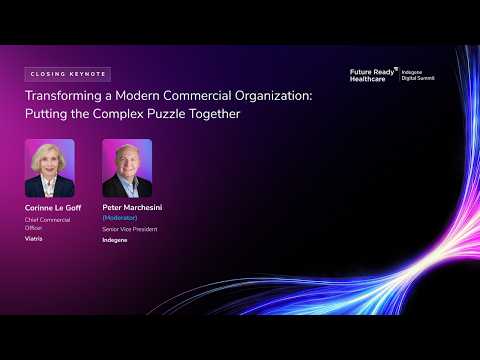
At the Indegene Digital Summit 2026, Corinne Le Goff, Chief Commercial Officer at Viatris, joined Peter Marchesini, Senior Vice President at Indegene, for a leadership conversation on what it takes to navigate that uncertainty. Her central argument was clear: transformation cannot be treated as a one-time restructuring exercise. It is a leadership capability built around continually assessing what the organization will need next and acting before the environment forces the change.
Start With the Transformation the Business Actually Needs
There is no universal transformation playbook. Corinne contrasted Viatris' evolution from a business centered on established products toward an organization with an innovative pipeline with Moderna’s rapid shift from a clinical development organization into a global commercial enterprise during the pandemic. Both required transformations, but the starting conditions, capabilities, timelines, and business imperatives were fundamentally different.
That makes diagnosis the first leadership responsibility. Leaders need to continually scan capabilities, identify gaps, and, critically, create alignment around which gaps matter. Transformation begins not with reorganizing teams, but with establishing a shared view of what the strategy requires the organization to become.
For pharma leaders, the implication is important: copying another company’s transformation model may create activity without building the capabilities the strategy actually demands.
Build the Organizational Puzzle Around the Future
Corinne described commercial transformation as assembling a jigsaw puzzle. The “four corners” are the foundational capabilities: marketing and pipeline prioritization, data and analytics, market access and health economics, and the operating teams spanning sales, marketing, and medical affairs. The task is not simply to strengthen each independently, but to evolve them together as the commercial environment changes.
That can require building capabilities that previously did not exist. A company moving from established brands toward innovative medicines, for example, may suddenly need sophisticated market access capabilities and value dossiers. In analytics, geographically fragmented approaches may need to give way to common decision frameworks, with centralized modeling complemented by local market input.
The larger principle is future-back organization design. As Corinne put it, leaders are not building for two years ago. They are building for the next decade. AI therefore matters not as another capability to bolt onto today's organization, but as one of the forces determining what tomorrow’s organization should look like.
Treat Foresight as An Operating Capability
Building for the future also requires leaders to distinguish emerging structural shifts from short-term noise. Corinne pointed to international reference pricing and the most-favored-nation debate as examples of developments the industry has been able to see forming over many years.
The strategic advantage comes from translating those signals into organizational choices before they become immediate pressures. Changes in pricing policy can influence where companies launch products. Shifts in healthcare funding can alter market attractiveness. Advances in particular scientific ecosystems can change where companies build capabilities and partnerships.
This moves foresight beyond the strategy function. For pharma leaders, the ability to identify consequential trends early and convert them into investment, capability, and market decisions becomes part of how the organization maintains competitiveness.
Design for the Business You Will Eventually Become
Few examples illustrated this future-back mindset more clearly than Moderna. During the pandemic, Corinne described simultaneously managing extraordinary commercial demand and building an organization for a post-pandemic reality that would look dramatically different.
Moderna opened 20 affiliates in nine months. Speed was essential, and mistakes were inevitable. But the more consequential question was what would remain useful when pandemic conditions disappeared, government access changed, revenues normalized, and investors began scrutinizing capital allocation differently.
The lesson extends well beyond hypergrowth. Organizations can easily design structures around today’s exceptional conditions, whether those are a blockbuster launch, a new technology cycle, or a temporary market opportunity. Leaders instead need to ask what capabilities, cost structures, and operating models will still make sense when those conditions change.
For pharma executives, transformation therefore requires two clocks: delivering against today's urgency while simultaneously designing for tomorrow's economics.
Make Talent Decisions at The Speed of Strategy
Building new capabilities inevitably changes the talent equation. Corinne argued that leaders must keep their talent base aligned not only with company strategy but also with technological change, continually upskilling existing teams while being willing to hire externally when capabilities do not exist internally.
That requires decisiveness. Waiting for legacy structures or roles to naturally evolve can leave the organization behind the strategy. Some capabilities can be developed internally; others may need to be brought in quickly.
But the future model may also challenge the idea of fixed organizational structures altogether. Corinne pointed toward more project-based, agile ways of working in which cross-functional teams form around a problem, solve it, dissolve, and reassemble around the next priority.
For leaders, talent strategy is therefore becoming less about filling a static organizational chart and more about creating a workforce that can continuously reorganize around changing business needs.
Reassess Where Innovation Will Be Rewarded
Extending the discussion from organizational design to global strategy, Corinne argued that pharma companies must continually reassess which markets will drive innovation, support clinical development, and reward investment.
Her own prioritization illustrates how quickly those assumptions can change. She highlighted China’s growing importance in target identification and development, South Korea’s specialization in areas such as antibody-drug conjugates, and the need to reconsider European market economics as governments balance healthcare spending against other priorities.
For companies building new commercial capabilities, global presence cannot automatically follow historical market hierarchies. Capital and organizational capacity are finite. Leaders increasingly need to make deliberate choices about where to build infrastructure based on where innovation, access, and commercial opportunity are heading.
The strategic question is no longer simply, “Where are our largest markets today?” It is, “Where will the conditions exist for our next generation of innovation to succeed?”
Keep the Patient as The Final Decision Filter
Amid organizational redesign, AI, changing roles, and shifting market economics, Corinne returned to one principle that should remain stable: patient centricity.
Drawing on her experience at Genentech, she recalled a corporate decision framework that began with a simple question before the P&L: Is it good for patients? That principle becomes even more important as technology creates distance between decisions and the people ultimately affected by them.
AI may change how clinical trials are designed, how commercial organizations operate, and how decisions are made. But medicines are still ultimately given to real people. Patient impact therefore remains more than a cultural aspiration; it is a practical decision filter that can anchor organizations while almost everything else around them changes.
Transformation Is A Leadership Discipline
Collectively, the discussion at the Indegene Digital Summit 2026 reframed transformation as something broader than technology adoption or organizational restructuring. It is the discipline of continuously reading the environment, anticipating what the business will need, assembling the right capabilities and talent, and making difficult choices before the need for change becomes unavoidable.
The organizations best positioned for what comes next will not necessarily be those that predict the future perfectly. They will be those built to keep changing as the future arrives.
