


Capturing customer or user consent and preferences in pharma organizations is not just an option but a crucial necessity for ethical marketing. Respecting the privacy of your customers, including healthcare professionals (HCPs), patients, and caregivers, through consent-driven marketing practices promotes trust, credibility, transparency, and accountability.
By prioritizing consent, life sciences organizations can unlock the full potential of targeted communication and personalized marketing. Tailoring content to match their customers’ interests significantly enhances engagement and campaign effectiveness, ensuring a positive customer experience while complying with regional and global regulations that govern life sciences marketing. A strong consent backbone also empowers customers with control over their data. This empowerment, in turn, further reinforces the foundation of trust and loyalty between organizations and their customer base.
The Value of Consent-Driven Patient or HCP Personalization
By prioritizing consent, life sciences organizations can unlock the full potential of targeted communication and personalized marketing. Tailoring content to match their customers’ interests significantly enhances engagement and campaign effectiveness, ensuring a positive customer experience while complying with regional and global regulations that govern pharma marketing. A strong consent backbone also empowers customers with control over their data. This empowerment, in turn, further reinforces the foundation of trust and loyalty between organizations and their customer base.
Consent Management Best Practices for Pharma Brands
To successfully navigate this consent-centric approach, pharma organizations must embrace the key industry best practices listed below to build a marketing ecosystem that not only complies with regulations, but also respects the preferences and choices of their customers, establishing a lasting and mutually beneficial relationship.
Ensure transparency in data collection:
Ensure that data gathering and utilization practices are transparent, and customers have clear information about how their data will be used to personalize marketing activities. Additionally, it is imperative that organizations adhere to all relevant regional and global regulations governing data operations, such as the General Data Protection Regulation (GDPR) or the California Consumer Privacy Act (CCPA).
Provide an opt-in mechanism:
Introduce an opt-in strategy where your target audience can voluntarily provide their consent to collect their data and preferences and specify the data to be used for personalized marketing. As a result, the core idea of consent is upheld, and end users are given the power to make informed judgements that shape their experience with the brand. Consent can be obtained via a website sign-up form, the registration/log in section of applications, an in-person meeting, an email, or other digital/physical means.
Enable granularity in consent capture:
Provide users with granular consent choices, allowing them to select marketing messages they want to receive and the degree of personalization with which they are comfortable. Instead of a binary choice, offer them the option to choose the specific types of marketing activities they are comfortable receiving, such as receiving emails but not phone calls or receiving information on new product launches but not clinical trials. This gives people control over their preferences and helps build trust with the brand while still enjoying personalized experiences.
Ensure user-managed consent:
It is important to provide customers with mechanisms that allow easy access for reviewing and changing their consent choices at any time, including the ability to withdraw or revoke their consent. By providing easy access, flexibility, and clear communication regarding consent choices, organizations empower customers to customize their marketing experiences and maintain control over their consent. This approach fosters trust, transparency, and respect for customer preferences, contributing to a positive customer experience and strengthening the organization’s commitment to privacy and data protection.
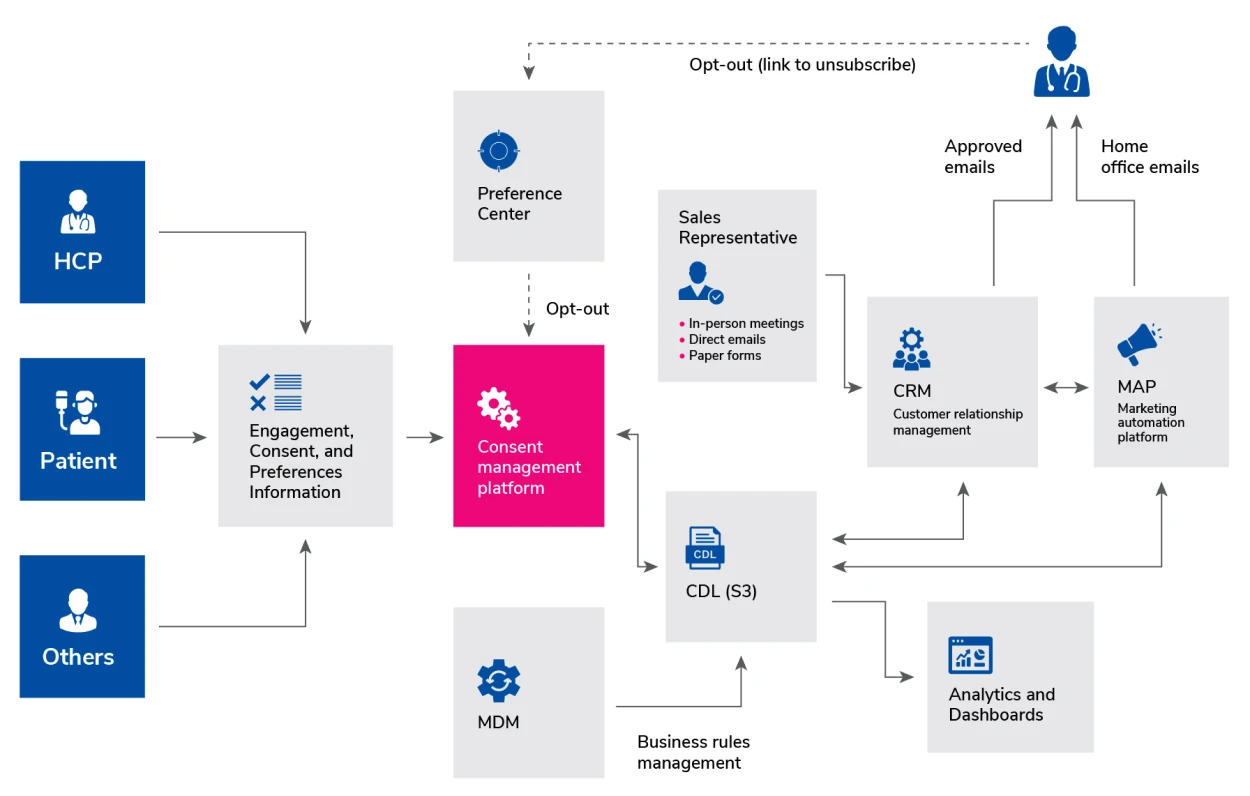
Ensure transparent data gathering and utilization practices:
Ensure customers have clear information about how their data will be used to personalize marketing activities.
For the EU, this applies compliance with the GDPR, which mandates lawful basis for processing, clear opt-in consent, and the right to be forgotten. Life sciences marketers must also now monitor updates under the Digital Services Act (DSA) and Digital Markets Act (DMA), especially when engaging through large platforms or targeting minors with health content.
DSA requires online platforms to be transparent about how they use personal data for targeting, especially when dealing with sensitive categories like health or when content may reach minors.
DMA restricts platforms to combine user data across services. For instance, if an organization is running a campaign that links data from 3rd party data and cookies, the DMA now requires users to explicitly consent to this data combination. These rules are reshaping how consent needs to be gathered, stored, and honored.
For the US, 16 states now enforce GDPR-like consent laws, and federal efforts like the Protecting Americans’ Data from Foreign Adversaries Act (PADFA) restrict how sensitive health data can be shared or sold. This demands consent management platforms that are not just compliant, but geo-aware, policy-adaptive, and capable of dynamic consent updates across channels.
Integrating Consent Management into your Pharma MarTech Ecosystem
To unlock the full potential of consent-driven marketing, pharma organizations must ensure that consent and preference data flows seamlessly across the entire marketing technology ecosystem. This includes brand websites, mobile apps, CRM platforms, marketing automation tools, and other engagement systems.
A well-integrated consent management platform or system acts as the backbone of compliant and personalized outreach. For an effective start, it should be connected to three core systems, each critical to orchestrating trusted, permission-based communication at scale.
Integrating your consent management system (CMS) with a centralized data lake:
Integrating consent data with the central data repository ensures compliance with data protection regulations, strengthens data governance, and provides enhanced data insights and analytics, which empower life sciences organizations to deliver superior customer experiences. A seamless integration also helps eliminate data silos and manual transfers of data, enhancing efficiency and accuracy in consent management.
Integrating your CMS with a CRM platform:
This integration allows pharma sciences organizations to effectively capture and link each individual’s consent choices to their customer profiles within the CRM system, which can then be used to enhance customer segmentation, targeting, and communication strategies . Having access to consent and preference data can also enable sales representatives to gauge the interests of customers when engaging with them through personalized email campaigns and tailored offers.
Integrating your CMS with marketing automation platforms:
Integrating your consent data with marketing automation platforms can ensure a seamless alignment of consent and preferences with automated marketing campaigns. Consent and preference data can be utilized to personalize and tailor workflows by adding consent-based triggers or decision points, thus driving higher conversions and much lower customer churn.
Leverage consent-aware AI workflows:
With generative AI playing a larger role in medical content and patient engagement, it is critical to ensure AI-generated outputs respect the boundaries set by consent preferences. Consent management systems should feed directly into AI models, so that content personalization or chatbot responses act within the ethical and regulatory frame defined by users.
Benefits of a Consent Management Platform
An enterprise-grade consent management platform is more than just a technology solution. It’s a strategic blend of people, processes, and systems designed to drive measurable business outcomes in pharma marketing.
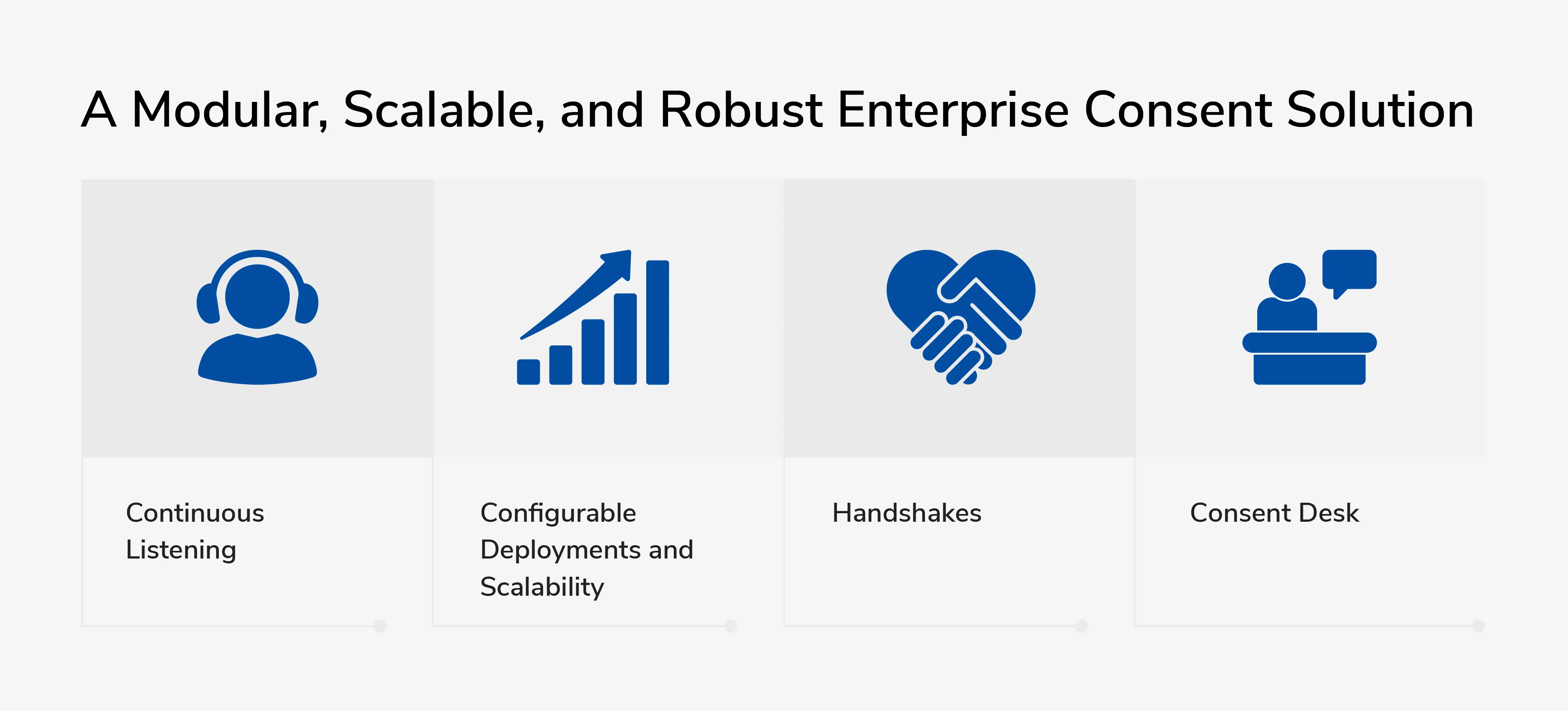
When implemented effectively, it enables continuous listening, ensuring your organization stays aligned with evolving regulatory requirements and market expectations. With configurable deployments, the platform supports granular opt-in/opt-out and preference capture, helping ensure compliance with global privacy laws.
A robust solution also brings scalability and efficiency through reusable templates, automation, and built-in governance. This reduces manual effort, minimizes errors, enhances analytics, and provides actionable insights to support ongoing optimization.
Regular handshakes between different groups both within and outside the organization helps promote transparency and consistency in consent processes, which is key to a strong consent management architecture that instils trust among stakeholders.
A dedicated consent desk, as the all-encompassing people layer, provides support for brand requests, query resolution, compliance monitoring , and audit support that future-proofs your consent management practices.
Built-in audit readiness and traceability can help conform to more intense regulatory scrutiny in 2025, especially around proof of consent lineage, and when, where, and how it was given, updated, or revoked. Modern consent platforms must support consent logs, time stamped audit trails, and role-based access (RBA) controls.
Explore how Indegene enabled enterprise consent management for a global pharma and medical device company.
New Consent Standards for AI Training
As pharma companies begin using personal data to train internal AI models, both consent mechanisms and consent language must evolve. Regulatory bodies, particularly under updated GDPR guidance and emerging U.S. state laws, now require organizations to explicitly disclose secondary uses of personal data, including for AI or machine learning training, and not just for direct marketing purposes.
This means companies must treat AI training as a distinct purpose, separate from general personalization or analytics. Consent management platforms must support this with purpose-tagged consent flags, clear opt-in/out options, and robust audit trails. Without this specificity, even well-intentioned data use could be deemed non-compliant, especially in high-sensitivity contexts like patient education, treatment reminders, or HCP targeting. Transparent, purpose-specific consent builds trust and future-proofs AI development efforts in an increasingly regulated environment.
Pharma Consent in 2025 and Beyond: Navigating Complex Privacy Laws Across States and Regions
As of early 2025, twenty U.S. states now enforce comprehensive privacy laws, and global regulations, including India’s DPDP Act, continue to evolve. Notably, GDPR updates emphasize that consent must be "freely given" (no pre-check boxes or implied consent) and must cover separate processing purposes with clear, meaningful user information.
For pharma marketers, this means auditable, purpose-specific consent logs are now mandatory. Integrating these requirements via policy-driven consent management platforms with real-time auditing capabilities ensures not only legal compliance but also strengthens brand credibility among HCPs and patients.
Key takeaways: Balancing Personalization and Privacy in Pharma
Transparency, consent-driven personalization, secure data handling, customer education, and continuous monitoring are key to a strong marketing strategy tailored to today’s world. Additionally, customers educated on the benefits of personalization can be empowered with control over their data, bridging the personalization-privacy paradox. Striking a perfect balance between personalization and privacy allows pharma marketers to deliver tailored experiences while respecting customer preferences and privacy concerns.
While a strong marketing technology portfolio can help in getting a quick boost in your key performance indicators (KPIs), proper understanding and implementation of this stack is the only way to achieve long-term success. Indegene offers decades of life science expertise, helping you successfully navigate today's rugged consent-centered commercialization landscape. We provide tailored solutions, combining people, processes, and platforms for long-term marketing success. Talk to us to learn more.
From Promise To Performance.
Trusted by all 20 of the world's top 20 pharmaceutical companies, Indegene helps life sciences organizations accelerate outcomes across the entire value chain.