SYNOPSIS: The previous evolution of rep-enablement software in healthcare was driven by new devices, integrated solutions, and the promise of cost savings through the software-as-a-service (SaaS) model that never materialized. Almost 10 years later, this approach to rep enablement has reached its limits in terms of utilization, effectiveness for modern rep roles, and driving further cost savings. Recent advances in technology have the potential to reduce or eliminate device and integration barriers for most pharmaceutical sales and marketing teams, and new advances in pharma-specific rep enablement software have introduced efficiency through result-based SaaS pricing and tailored applications that maximize utilization that allows reps to activate their HCPs in new ways.
Introduction
The landscape of pharmaceutical rep enablement software has undergone cycles of innovation every 8 to 10 years since the 1990s. Originally, rep enablement focused on sales force automation (SFA) through customer relationship management (CRM) software,1 and over time, the industry gradually added new capability enhancements such as digital content sharing, remote engagement, and mobile email correspondence, driving a trend toward detailing with digital sales materials.2
During the last wave of innovation in this space, the industry moved toward fully integrated, cloud-based, closed system SaaS platforms. The shift was primarily driven by the following factors:
Concerns about the technical complexity of integrating multiple best-in-class platforms and the corresponding user experience.
The introduction of tablet devices (mostly Apple iPads) as the standard rep tool to share content with HCPs.
An opportunity to replace capital and maintenance intensive software infrastructure with flexible and cost-effective SaaS solutions.
Ten years later, advances in technology and changes in rep and customer behavior have altered the commercial software landscape, and the low utilization rates for SaaS in healthcare have limited the cost benefits of this model while failing to deliver the expected flexibility.
By the early 2010s, many healthcare manufacturers viewed CRM as a mandatory cost regardless of utilization rates. In an effort to improve both utilization and rep effectiveness, the industry invested in CRM add-on features, adding new costs with only a marginal impact on overall rep effectiveness and limited success in increasing utilization rates.
Today, life sciences companies are increasingly concerned about fully maximizing their field force’s impact through technology and are exploring more modern approaches that promise higher effectiveness, higher utilization rates, and completely different cost structures.3

CRM Integration and User Experience
Rep enablement software originally focused on SFA through CRM software, allowing sales and marketing leadership to monitor customer interaction data for administrative purposes.
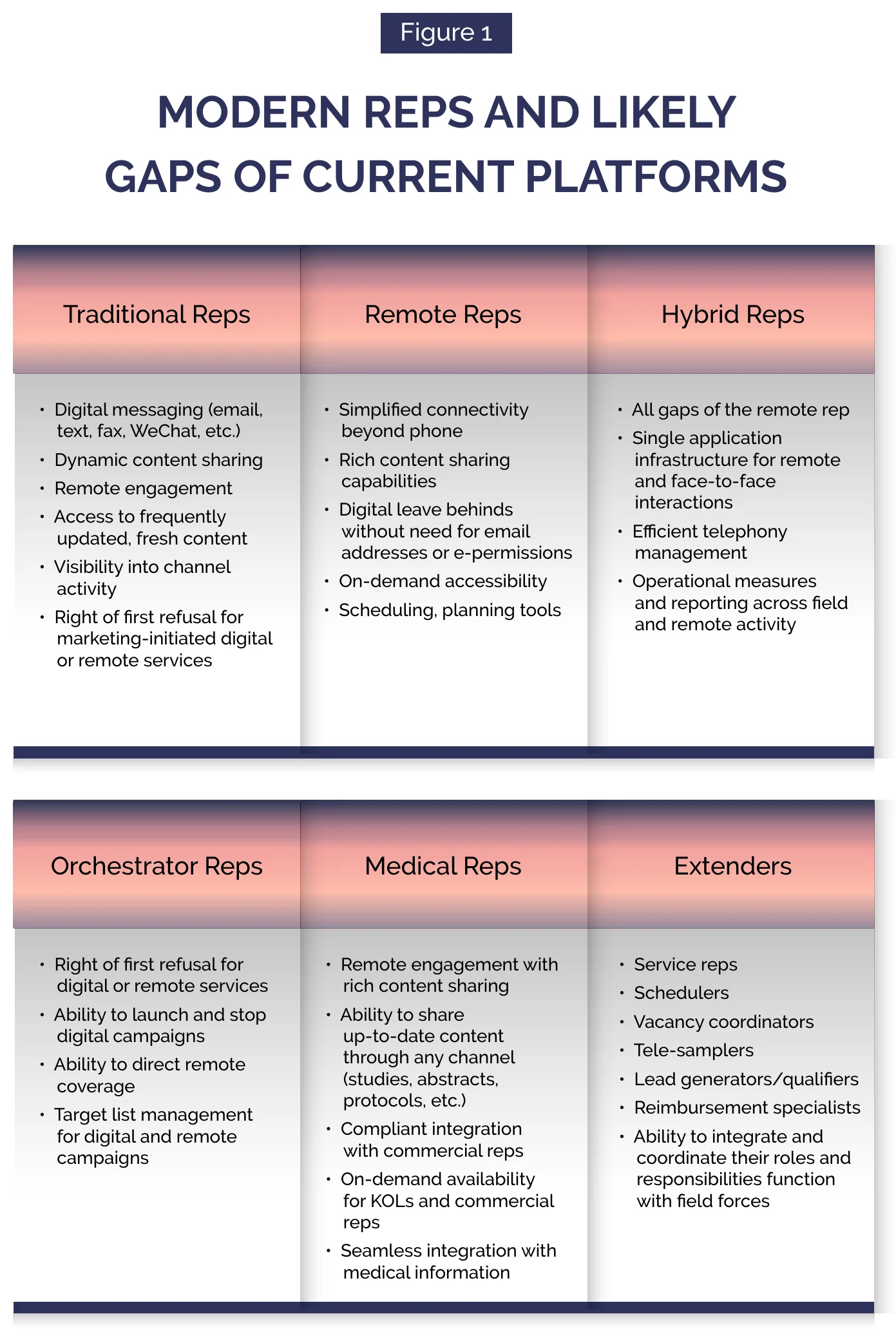
Changes in customer behavior and technology have increasingly demanded additional capabilities around HCP engagement and activation. Moreover, the role of reps has been evolving and modern reps now include multiple and different roles (medical, account, remote reps, etc) that have their own unique needs and challenges for activating their HCP customers.
Traditional CRM platforms have addressed this capability gap by developing add-on modules and selling pre-integration into the CRM ecosystem as the key competitive advantage over the best-of-breed stand-alone solution. Heretofore, the industry has accepted the limitations of a massive, monolithic, CRM-centric ecosystem for the promise of integrated data and has been willing to pay a premium for such platform. Recently, an increasing number of manufacturers and analysts are beginning to question the viability of such a “walled garden” ecosystem.
In addition to simply accepting gaps in enabling new capabilities, most companies have already added multiple point solutions or work-around strategies for critical capability needs of their reps on top of their large SaaS CRM subscriptions. This resulted in the opposite of the original intention, with reduced utilization, more hidden fees, impaired user flows, and poor data integration.
Moreover, a “walled garden” for reps centered around CRM software completely ignores the reality of the broader technology ecosystem reps operate in today, including calendars, email clients, and office productivity software.
Case Study 1
The Hidden Costs of Restrictive Add-On Modules
A mid-sized pharmaceutical company licensed the built-in rep emailing add-on within their CRM/CLM software for several thousand reps.
After just 3 months it became apparent that almost all reps had a need to discuss dynamic, data-driven formulary information with their customers and email the results of the discussion as a follow-up.
The add-on email client only supported delivery of pre-defined content, which led the company to develop a work-around with their agency partners. A flexible landing page was built, and a link was attached to the static email client.
The result was an added cost to develop new landing pages for each email template that required dynamic content. The approach doubled the expected costs of using the add-on module, and these fees remained hidden from SaaS ROI calculations.
The consumerization of software utilization in the workplace today demands agility and standardized integration across the entire ecosystem. In the new “app economy,” users expect to choose from a multitude of tools that meet their needs. Thus, the trend across industries is a departure from monolithic platforms and a push toward flexible applications that are designed to integrate in the larger ecosystem of the users’ work environment.
Micro-services architectures and “API-first” paradigms enable modern applications with a high degree of connectivity to such ecosystems, both among themselves and with traditional monolithic platforms that remain in the enterprise software set.
Today, integration via standardized APIs is the new norm, and essential to maximize utility. Modern solutions can provide this level of integration without the need for time and cost-intensive projects, and manufacturers are becoming less tolerant of solutions that try to force them into a closed ecosystem instead.
Integration and User Experience for Pharma Today
Modern enablement apps with APIs and micro-service architecture designs allow pharmaceutical companies to acquire a combination of best-of-breed tools to meet the needs of their reps while ensuring integrated data flow and maximizing HCP activation.
Moving away from the “walled garden” has become essential for enabling reps with the right tools while controlling SaaS cost.
Base CRM rep enablement software often started in the $100 per rep per month range, and the expansion of capabilities with one, two, or even three add-on modules easily inflates this rate by 50% average and as high as up to 250% as closed ecosystems can charge a premium for add-on modules.
Many are now investigating third-party apps in light of loss of quality and utility seen with the built-in add-on modules that are further removed from the core competency of the base CRM.
Figure 1 reveals the nature of today’s new rep roles and the unique requirements these teams need from rep enablement technology.
Multi-Platform Content Needs
Another concern of the “walled garden” is the complexity and cost of platform-specific content needs. The most commonly used systems today rely on the content that is very specific to its platform. CRM developers encouraged companies to operate within the parameters of the closed ecosystem to ensure interoperability of content across its own add-on systems.
This approach results in costly content development operations to support the platform in addition to all the content that is not executed by the field representatives (bulk email, web, marketing communications, etc). The added cost of content development and retooling far exceeds the actual cost of the software itself and limits the usability of the content outside the platform.4
Case Study 2
Hidden Costs of Restrictive Content Protocols
A top 20 pharmaceutical company in the United States implemented a closed ecosystem with CRM, CLM, and a rep-to-doctor email client. Upon recognizing the scale and complexity of content production for the platform, a single production specialist was chosen to centrally produce, publish, and deploy the content received from multiple agencies across all brands and enabled a 60% reduction in the production cost.
Despite this centralized and highly efficient approach, content production cost still exceeded $3 MN per year in the United States alone just to ensure availability of content within the CRM ecosystem and interoperability across its own add-on modules.
Modern apps no longer require decision makers to compromise on utility for integration. Micro-service foundations enable reps to choose tools that truly enable their role and maintain strong data flow between other applications, similar to the ones consumer already expect and experience on their smartphones.
New Devices and Content Standards
The introduction of Apple’s iPad sparked a rapid migration of healthcare manufacturers to enable their field representatives with digital content. In just a year after release, 40% of all the field reps were using iPads, and 70% of non-users planned on implementing the device within 12 months.5
The iPad also sparked a new generation of iPad-based SFA/CRM software with integrated content viewers to enable closed loop marketing (CLM) through face-to-face engagements between reps and their HCPs while using digital content. This approach promised greater utilization and effectiveness by field teams, and many were eager to transform the CRM into a mobile-first orientation.
Unfortunately, the general trend toward users bringing their own device and the consumer preference for smartphones and phablets over tablets made the iPad-centric push a challenge6; moreover, the use of mobile CRM tools revealed the limitations of the existing platforms and most (67%) felt they outgrew their CRM within a year of implementation.7
Content Restrictions and Device Growth Collide
The add-on modules for CRMs restricted content flexibility; however, as the number of devices grew, bring-your-own-device (BYOD) policies became the standard. In this environment, the confinement of content to a specific application on a specific device decreases utility and usability and greatly reduces the rep’s ability to activate their HCPs through any channel the HCP chooses to use.
Case Study 3
When Multiple Devices Meet Device-Restrictive CRMs
A top 10 pharma company using a closed ecosystem SFA/CRM and CLM solution running on iPads licensed the built-in remote engagement add-on module. Promotional content was only accessible on the iPad and within the platform.
This created two issues
1 Call center and hybrid reps operating remotely required desktop call center systems and could not share iPad content without also needing the tablet device and a complex setup process to connect the iPad to the desktop. All this resulted in many manual steps and reduced call activity per hour.
2 Field reps required the HCP’s email address and utilization of an email as a third channel to provide unique links for the connection. Email addresses in the CRM were often incorrect or outdated, and sometimes the HCPs were not willing to share their email addresses. The required use of the internal rep email system complicated the approach by mandating the use of yet another channel for remote connection. Overall, the field utilization remained low.
New Content Standards Become Essential for Operations
Content is a fundamental enabler of an effective multichannel strategy. The sales, marketing, and medical teams face restrictive cost barriers and complexity for content creation without the ability to simply create and universally reuse digital content across all channels. Ultimately, these barriers reduce engagement efforts to a few channels that fit the device and CRM protocols.
HTML5 standards allow for content that is consumable across any device or browser. Although a few are yet to fully adopt the HTML5 standards across all digital content, the approach provides a greater degree of channel flexibility and several associated benefits as given below:
Content can be reused on any channel, shared with HCPs through their preferred medium, and easily customized/updated for other purposes.
Reps can use the device they are most comfortable with or that is most useful for a given engagement situation.
Device familiarity reduces barriers to utilization.
Ability to access the same content on a mobile device during a face-to-face meeting and on a desktop during a remote meeting gives reps the necessary flexibility/ease-of-use to successfully activate their HCPs.
HCPs can connect to their reps in multiple ways that are convenient to them without having to download applications, plug-ins, or engage in other burdensome activities that reduce engagement.
SaaS Reality for the Healthcare Industry
With the emergence of cloud computing, SaaS adoption rates have spiked in many industries including healthcare. SaaS has allowed companies to avoid eight-figure capital expenditures with the shift toward per-user costs.
The SaaS transition in life sciences allowed for many cost benefits. However, as SaaS adoption of CRM peaked, many found that their expectations of flexibility and platform switching were not met.
Today, SaaS has become a costly and mandatory per-rep expense, regardless of the actual utilization by the rep. Because these costs are assumed to be a mandatory cost, the true ROIs of these platforms are seldom measured for overall effectiveness.
The promise of simple SaaS rollouts did not materialize, and platforms still required complex implementations, lengthy systems integration projects, recurring training costs, and complex change management initiatives. Once implemented, the barrier to implementing better alternatives to their SaaS CRM is often the fear of organizational cost and disruptions even though new rep roles in pharma increasingly demanded unique tools and functionality (see Figure 2).
Today, the rep enablement environment in the life sciences industry represents a “one size fits all” approach, with mandatory administrative tasks imposed on all users, and few leveraging the core platform and its add-on modules for pre-call planning and HCP engagement. The HCP channel today is poorly activated with most HCPs (89%) restricting rep access8 and most reps (78%) indicating they do not make use of the tools provided by their company.9 Field rep productivity in the life sciences industry has declined by 58% over the last 5 years alone, hardly testifying to the effectiveness of multimillion dollar CRM platforms.10
SaaS Has Become a Fixed Cost Regardless of Utilization
Sales and marketing costs in life sciences have grown exponentially,11 and many SaaS platform providers drive their growth by piling on new fees for the “must-have” add-on modules that are not utilized by the field team.
On the contrary, trends at the provider and payer levels are forcing life sciences manufacturers to engage in outcome-based partnerships that link payments to results.12 This trend extends more and more to the relationship between the manufacturers and their suppliers; hence, the industry is seeking technology partners who can better align their pricing models with these outcome-based trends they experience with their own customers.
In simple words, as healthcare manufacturers are increasingly paid for outcomes, they expect their service and technology partners to follow the same trend. A SaaS supplier needs to become a partner in ensuring utilization and delivering business outcomes and not just charging for the deployment of software.
Figure 2 reveals the typical pricing structure of a SaaS platform. A model that prices for outcomes and utilization should already include:
Broad access to the right applications that meet the needs across diverse rep roles instead of incrementally charging for the addition of individual capabilities.
Expertise in end-to-end deployment, training, and ongoing operational support to ensure success.
Integration with key applications and platforms across the reps’ ecosystem to ensure smooth data and user workflows.
Content and services at the rep level for ongoing user engagement and success.
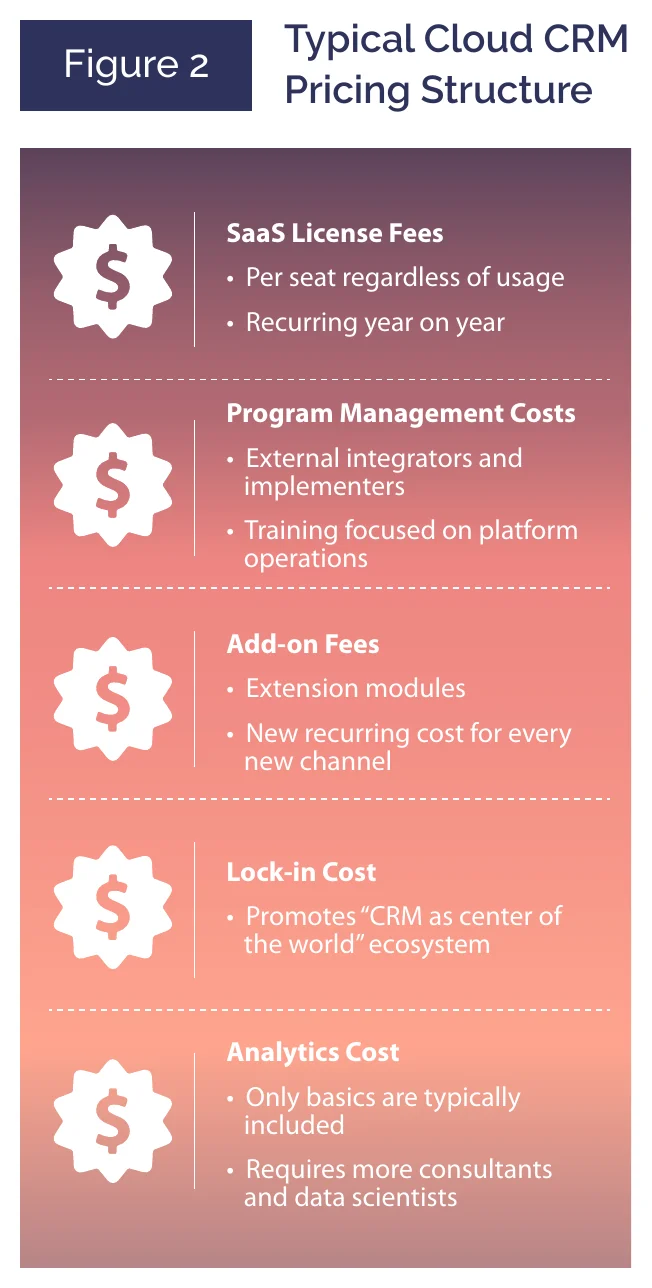
A utilization or outcome-based SaaS partner for a healthcare sector should include all aspects of successful utilization within their licensing fees. This includes technology rollout, ongoing operations, and every tool a rep would need to maximize their business outcomes. In this model, better utilization by the reps leads to higher levels of HCP activation and business outcomes, resulting in higher utilization fees for the SaaS provider.
This approach enables healthcare manufacturers to innovate more easily with respect to commercial software, while enabling modern sales and marketing teams with a budget that truly reflects front-line success.
Conclusion
The rep team in a typical life sciences company now includes diverse field, remote, hybrid, medical, and extender rep roles, all of which require unique tools and capabilities that are specific to their needs in driving business outcomes.
Regardless of the role, the digital channels and rich, varied content have become mandatory aspects of successful customer activation. BYOD policies and multichannel mobile device access demand solutions that allow content to be utilized and shared without channel, device, or platform restrictions.
The consumerization of enterprise software has introduced the next innovation cycle of new sales tools, and API protocols with micro-service architectures are removing barriers of integration to allow for effective best-of-breed ecosystems.
As life sciences companies expand from monolithic platforms and advance toward these modern, more nimble, and effective ecosystems, a utilization- or outcome-based cost approach becomes increasingly crucial for innovation and adaptability by removing the risk of ineffective technology expenditures.
Over time, the correct approach will see healthcare manufacturers shifting appropriate and successful capabilities to a utilization-based platform, cutting excessive add-on modules from the operations budget in favor of a partner
References
01. Kurtz, D. (2006). Medtech Firms are Reexamining the Benefits of Customer Relationship Management Systems and Finding Implementation Easier This Time Around. Retrieved from Kurtz Consulting: http://www.debrakurtz.com/article_2.asp
02. Myshko, D. (2004, March). Technology Makes CRM Possible. Retrieved from PharmaVOICE: http://www.pharmavoice.com/article/153/
03. Accenture Life Sciences. (2013, January). Life in the New Normal: The Customer Engagement Revolution. Retrieved from Accenture Life Sciences: http://www.accenture.com/us-en/Pages/insight-pharma-analytics-digital-commercial-survey.aspx
04. Weintraub, S., Lewis, R., McHugh, J., Zan, R., & Sitler, B. (2015, July 1). The Future of Pharmaceutical and Healthcare Marketing. Retrieved from Google Books: https://books.google.ca/books?id=pAFOCgAAQBAJ&dq=too+many+sales+tools+in+pharma&source=gbs_navlinks_s
05. Red Mountain Insights LLC. (2012, October). iPad and Smartphone Use in the Pharma Industry. Retrieved from Research and Markets: http://www.researchandmarkets.com/research/zzz8bj/ipad_and
06. I-CIO. (2012, October). BYOD: Four Case Studies Show the Reality Behind the Hype. Retrieved from I-CIO: http://www.i-cio.com/strategy/mobile/item/byod-four-case-studies-show-the-reality-behind-the-hype
07. Majumder, D. (2012). Is Generic Pharma CRM up for this Challenge? Retrieved from Medismo: http://medismotech.com/generic-crm-vs-byo-vs-specialized-pharma-crm/
08. HealthLink Dimensions. (2016, March 7). Annual Healthcare Professional Communication Report 2016. Retrieved from HealthLink Dimensions: http://www.healthlinkdimensions.com/guides/annual-healthcare-professional-communication-report-2016/
09. Smilansky, O. (2016, August). Salespeople Need Better, but Fewer, Tools. Retrieved from Destination CRM: http://www.destinationcrm.com/Articles/Columns-Departments/Insight/Salespeople-Need-Better-but-Fewer-Tools-112509.aspx
10. Accenture. (2016, September 27). Productivity Initiatives Distracting Sales Teams and Stifling Business Performance, Accenture Strategy Study Finds. Retrieved from Accenture: http://www.newswire.ca/news-releases/productivity-initiatives-distracting-sales-teams-and-stifling-business-performance-accenture-strategy-study-finds-594931221.html
11. Olson, R. (2015, March 1). Design Critique: Putting Big Pharma Spending in Perspective. Retrieved from Randal S Olson Blog: http://www.randalolson.com/2015/03/01/design-critique-putting-big-pharma-spending-in-perspective/
12. Accenture Life Sciences. (2015). The Rebirth of the Pharmaceutical Sales Force. Retrieved from Accenture: https://www.accenture.com/t20150723T015908__w__/us-en/_acnmedia/Accenture/Conversion-Assets/DotCom/Documents/Global/PDF/Dualpub_13/Accenture-Rebirth-Pharmaceutical-Salesforce.pdf
From Promise To Performance.
Trusted by all 20 of the world's top 20 pharmaceutical companies, Indegene helps life sciences organizations accelerate outcomes across the entire value chain.